任
Character Story & Explanation
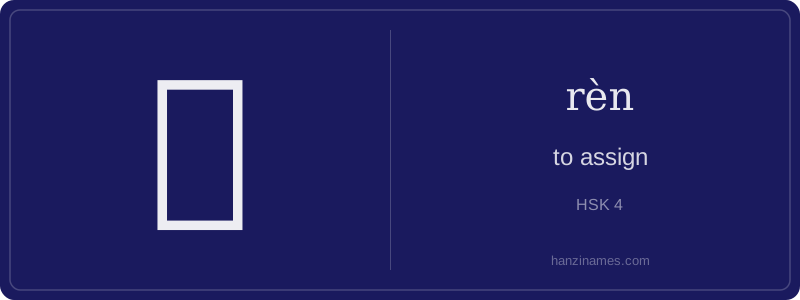
In daily life, 任 appears ubiquitously in official and professional contexts: 任命 (rènmìng, 'appointment'), 任务 (rènwù, 'task'), and 任期 (rènqī, 'term of office'). It’s central to China’s civil service system—officials are formally 任命 by party committees, a practice documented since the Ming dynasty and codified in the 1993 Civil Servants Law. The idiom 任重道远 (rèn zhòng dào yuǎn, 'the burden is heavy and the road is long') originates from the Analects (8.7), describing moral duty.
The written form has no oracle-bone record; earliest attestation is in Warring States bamboo slips. Its structure is consistently phono-semantic: 亻 (person) + 壬 (phonetic, also evoking upright support). Today, Chinese students write it early—HSK 4—and see it on government notices, job postings, and university course registration portals where roles are formally assigned.
Our detective begins at the crime scene: the character 任 (rèn). Early seal script shows a human figure (radical 亻) beside a phonetic component 壬 (rén), which originally depicted a vertical pole or pillar—symbolizing support, authority, and structural responsibility. This pairing wasn’t accidental: assigning duty requires both a person *and* a framework of accountability.
By the Han dynasty, 任 had crystallized into its modern form—six strokes, left-right structure—with consistent semantic focus on delegation and trust. Unlike characters that evolved pictorially (e.g., 日 for 'sun'), 任 is a phono-semantic compound: 亻 signals humanity/agency, while 壬 provides sound and conveys weightiness. Its stability across 2,000+ years reflects how deeply embedded ‘assignment’ is in Chinese administrative and ethical thought.
The character’s quiet power lies in its duality: it means both ‘to assign’ (as an action by authority) and ‘to assume’ (as personal acceptance of duty). This mirrors Confucian ideals where appointment (rèn mìng 任命) and self-cultivation (rèn xìng 任性, though later acquiring a negative nuance) stem from the same root—responsibility as relational obligation, not mere task distribution.
Example Sentences
Common Compounds
Similar Characters — Don't Mix These Up
Your First Step into Chinese Culture: Get a Chinese Name
Every journey into Chinese begins with a name. Use our free Chinese name generator to create a meaningful, personalized Chinese name that fits you perfectly.
Get My Chinese Name →