份
Character Story & Explanation
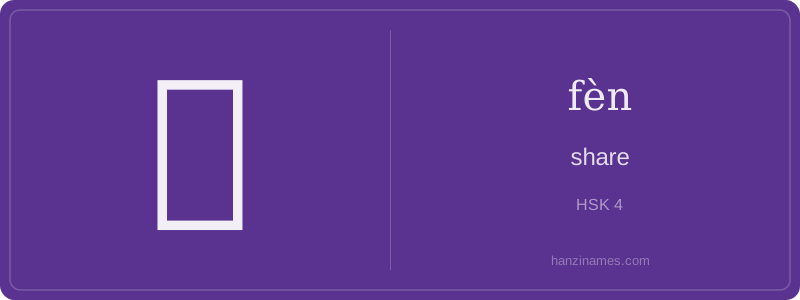
In daily life, 份 is indispensable for counting formal, document-like, or gift-oriented items: you buy 一份合同 (a contract), submit 一份报告 (a report), or give 一份贺礼 (a congratulatory gift). It appears in official contexts like government notices (一份文件) and media (一份杂志). The phrase 有份参与 ('had a share in participating') is common in resumes and meeting minutes—reflecting value placed on documented contribution. Historically, 份 entered widespread use during the Ming–Qing dynasties in legal and commercial documents, where precise quantification of obligations and entitlements was essential.
The character combines the 亻 (person) radical with 分 (fēn, 'to divide'). Its origin is semantic-phonetic: 分 provides both sound (cognate with fèn via tone shift) and meaning—'division into socially recognized portions'. No oracle-bone form exists; it first appears in standard clerical script during the Han dynasty as a specialized classifier for apportioned, person-related entities.
The character 份 (fèn) embodies the Chinese cultural emphasis on relational precision and social appropriateness. Unlike English, which often uses generic quantifiers like 'a' or 'some', Mandarin deploys classifiers to signal not just quantity—but context, formality, and function. 份 marks items that carry social weight: a gift isn’t just ‘one’—it’s one *份*, implying intention, reciprocity, and face. This reflects Confucian values where even grammar encodes duty and role-awareness.
As a classifier, 份 subtly structures reality by categorizing things according to their societal purpose—not physical shape or animacy (like many other classifiers), but their role in human exchange. A newspaper (一份报纸), a contract (一份合同), or a wedding gift (一份礼) all become socially sanctioned units. This linguistic habit trains speakers to perceive objects through the lens of relationship, obligation, and shared understanding—making language itself a vessel of collective ethics.
Moreover, 份 appears in abstract nouns like 身份 (shēnfèn, 'identity') and 缘分 (yuánfèn, 'fated connection'), revealing how deeply classification bleeds into metaphysics. Here, 份 conveys an allotted, meaningful portion—of fate, status, or belonging—that cannot be arbitrarily assigned. It suggests a worldview where identity and connection are not self-determined but socially conferred and linguistically marked—a quiet affirmation that meaning arises in relation, not isolation.
Example Sentences
Common Compounds
Similar Characters — Don't Mix These Up
Your First Step into Chinese Culture: Get a Chinese Name
Every journey into Chinese begins with a name. Use our free Chinese name generator to create a meaningful, personalized Chinese name that fits you perfectly.
Get My Chinese Name →