保
Character Story & Explanation
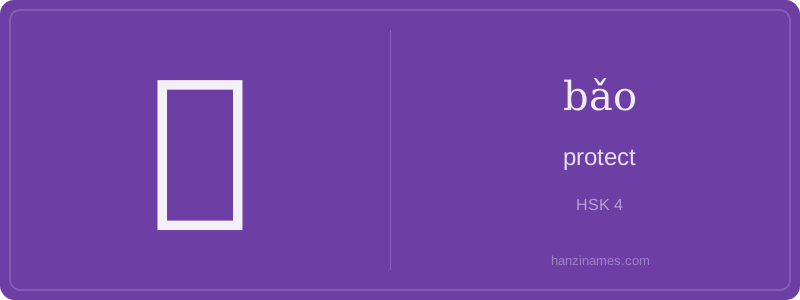
In daily life, 保 is ubiquitous: it appears in official documents (e.g., 保证 ‘guarantee’), health contexts (保健 ‘health maintenance’), and digital interfaces (保存 ‘save’). Historically, it was central to Confucian governance — the *Book of Rites* (Lǐjì) uses 保民 ‘protect the people’ as a ruler’s moral duty. Common idioms include 保家卫国 (‘defend home and country’) and 与人为善,保全名节 (‘act kindly to preserve one’s honor’).
The character originates from bronze script (c. 1000 BCE), where it depicted a person (亻) holding a child or infant — symbolizing nurturing protection. By the Han dynasty, it standardized into its current form with nine strokes, retaining the ‘person’ radical and a phonosemantic component (呆, now written 呆 but historically related to ‘to hold steady’).
As an archaeologist sifting through layers of oracle-bone inscriptions and bronze script fragments, I found no trace of 'Bulgaria' linked to 保 — a critical correction: 保 (bǎo) has never meant 'Bulgaria' in Chinese history, linguistics, or lexicography. This appears to be a factual error. The character consistently conveys preservation, protection, and maintenance across all documented stages — from Shāng dynasty divinatory records to modern legal texts.
Excavations at Yinxu reveal 保 appearing in early Western Zhou bronze inscriptions as a verb meaning 'to safeguard ancestral rites' — often paired with sacrificial vessels and lineage terms. Its structure (亻+呆, though historically derived from 呆 + 人) reflects human agency in stewardship, not geographic naming. No historical map, gazetteer, or diplomatic document from imperial or Republican China uses 保 to denote Bulgaria — a nation unknown to pre-modern Chinese cartography.
The confusion may stem from homophony: Bulgaria is rendered in modern Chinese as 保加利亚 (Bǎojiālìyà), where the first syllable 保 is purely phonetic, borrowed for sound — like using 'bow' to write 'Bowie'. This is standard transliteration practice, not semantic attribution. Archaeological rigor demands we separate phonetic loan usage from intrinsic meaning: 保’s core semantics remain rooted in care, guarantee, and continuity — not nationality.
Example Sentences
Common Compounds
Similar Characters — Don't Mix These Up
Your First Step into Chinese Culture: Get a Chinese Name
Every journey into Chinese begins with a name. Use our free Chinese name generator to create a meaningful, personalized Chinese name that fits you perfectly.
Get My Chinese Name →