俩
Character Story & Explanation
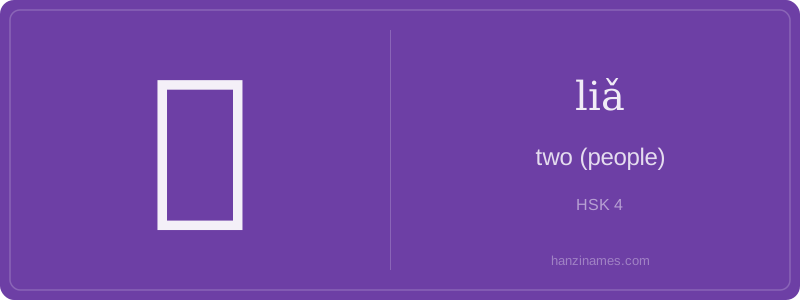
俩 is widely used in modern spoken Mandarin, especially in northern China and Beijing dialect. It appears frequently in everyday speech, TV dramas, and informal writing — such as 微博 (Weibo) posts or chat messages. While not found in classical texts, its usage is well-documented in 20th-century vernacular literature and language surveys (e.g., the 1986 Modern Chinese Dictionary explicitly lists it as a colloquial contraction of 两个). It’s absent from formal documents, exams, or news broadcasts, where 两个 is required.
The character 俩 is not pictographic — it evolved from cursive handwriting of 两个. Its left radical 亻 (person) signals human reference, while the right component 两 (liǎng) carries the 'two' meaning. This structure reflects its grammatical role: exclusively for counting people informally.
Hi students! Let’s learn 俩 (liǎ) — a friendly, colloquial way to say 'two' in Chinese. Unlike the formal number 二 (èr) or the quantifier 两 (liǎng), 俩 is a contraction: it combines the number 'two' and the measure word 'individuals' (i.e., 两个 → 俩). It’s used *only* before nouns referring to people — never for objects, animals, or abstract things. You’ll hear it all the time in spoken Mandarin, especially in northern dialects and daily chats.
Pay attention to tone: it’s third tone (liǎ), not second (liá) or fourth (lià). And remember — 俩 is always informal and cannot stand alone. You can’t say 'I have 俩'; you must say 'I have 俩朋友' (I have two friends). It’s like a built-in 'two + people' package — efficient, warm, and very human-centered.
This character is also special because it’s one of few Chinese characters that *only* exist as contractions — it has no classical or literary standalone use. Its simplicity (just 9 strokes!) hides deep linguistic efficiency. As an HSK Level 4 word, mastering 俩 helps you sound more natural and fluent in real conversations — not textbook-perfect, but authentically Chinese.
Example Sentences
Common Compounds
Similar Characters — Don't Mix These Up
Your First Step into Chinese Culture: Get a Chinese Name
Every journey into Chinese begins with a name. Use our free Chinese name generator to create a meaningful, personalized Chinese name that fits you perfectly.
Get My Chinese Name →