倍
Character Story & Explanation
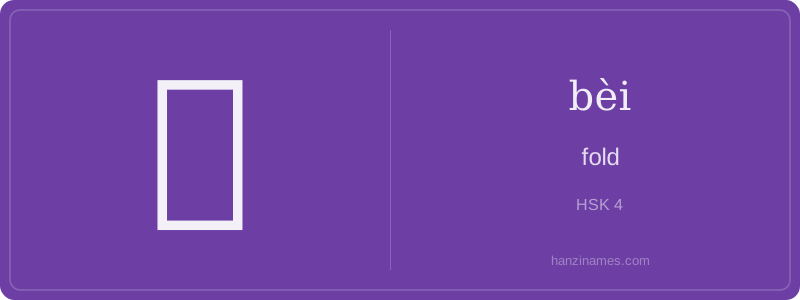
In Shanghai’s Pudong district, a tech startup founder explains funding growth to investors: “我们的用户量比两年前增长了四倍。” (Wǒmen de yònghù liàng bǐ liǎng nián qián zēngzhǎng le sì bèi.) — 'Our user base has grown fourfold compared to two years ago.' This usage is standard across Chinese media, government white papers, and corporate earnings calls. Common phrases include 成倍增长 (chéng bèi zēngzhǎng, 'exponential growth') and 翻倍 (fān bèi, 'to double'), both widely documented in the People’s Daily and CCTV financial reports.
The character 倍 is not pictographic; its earliest attestation is in Warring States bamboo texts (c. 4th century BCE), where it consistently functions as a multiplier. The left radical 亻 (person) hints at human agency in measurement, while the right component 咅 (bèi) serves phonetic and semantic reinforcement — historically linked to 'matching' or 'corresponding' quantities. No oracle bone form exists; its structure stabilized during the Han dynasty.
The Chinese character 倍 (bèi) expresses multiplicative relationships—'times', 'fold', or 'multiple of'. Unlike English, where we say 'three times bigger', Chinese uses 倍 to indicate exact proportional increase: 三倍 means 'three times as much', not 'three times bigger' (which would be ambiguous). It’s a precise mathematical and comparative tool deeply embedded in daily communication—from salary negotiations to news reports on economic growth.
Grammatically, 倍 always follows a number or quantifier and precedes the noun or verb phrase it modifies. Crucially, it never stands alone; it requires context like a base quantity (e.g., 比去年多三倍 — 'three times more than last year'). Misplacing it leads to confusion, especially for learners who might conflate it with adjectives like 多 or 高. Its usage reflects China’s cultural emphasis on measurable progress and quantifiable achievement.
At HSK Level 4, 倍 marks a turning point where learners move beyond basic counting into nuanced expression of scale and comparison. It appears frequently in official statistics, business reports, and education contexts—for instance, describing how high-speed rail mileage has increased fivefold since 2010. Mastery of 倍 enables learners to comprehend real-world data and articulate relative change accurately, bridging language learning with critical literacy in modern Chinese society.
Example Sentences
Common Compounds
Similar Characters — Don't Mix These Up
Your First Step into Chinese Culture: Get a Chinese Name
Every journey into Chinese begins with a name. Use our free Chinese name generator to create a meaningful, personalized Chinese name that fits you perfectly.
Get My Chinese Name →