幸
Character Story & Explanation
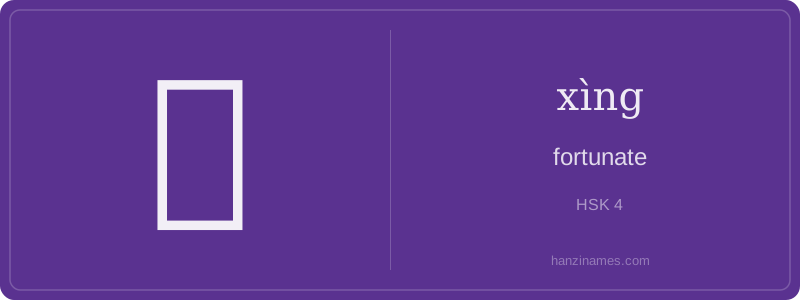
In China today, 幸 appears ubiquitously in public life: government reports cite '人民幸福' (rénmín xìngfú, 'people’s happiness') as a core development metric; subway announcements wish commuters '一路平安,幸福安康' ('safe travels and lasting happiness'); and social media posts ending with '祝你幸福!' ('Wishing you happiness!') are common farewells. The phrase 幸灾乐祸 (xìng zāi lè huò, 'to rejoice at others’ misfortune') is a documented classical idiom—first recorded in the 11th-century *Zizhi Tongjian*—highlighting 幸’s ancient moral duality: joy derived from fortune versus joy derived from others’ suffering.
The character’s earliest attested form appears in bronze inscriptions of the Western Zhou dynasty (c. 1046–771 BCE), where it depicted a prisoner with shackles (the top part resembling handcuffs, now simplified to 土 + 羊-like strokes), symbolizing 'being spared punishment'—hence 'fortunate'. Over time, its punitive origin faded, and by the Han dynasty, it had evolved into its current shape and benevolent meaning.
The character 幸 (xìng) carries the warm, uplifting meaning of 'fortunate' or 'blessed'—a concept deeply embedded in Chinese values around gratitude, humility, and harmony. Unlike Western notions of luck as random chance, 幸 often implies being favored by circumstance, virtue, or benevolent forces—making it central to expressions of hope, well-wishing, and emotional resilience.
In daily usage, 幸 appears in both formal and heartfelt contexts: from official slogans like '幸福是奋斗出来的' ('Happiness is achieved through hard work') to handwritten New Year couplets wishing families '平安幸福' ('peace and happiness'). Its positive weight makes it a cornerstone of Chinese emotional vocabulary—never used lightly, always with sincerity.
Though visually simple (8 strokes, radical 干), 幸’s cultural resonance is profound. It rarely stands alone in modern speech but thrives in compounds—especially those affirming life quality (e.g., 幸福, 幸运). Learners should note its tone: fourth tone (xìng), sharp and falling—like a decisive nod of appreciation. Mispronouncing it as xīng (first tone) risks confusion with 星 ('star'), underscoring why tone mastery matters.
Example Sentences
Common Compounds
Similar Characters — Don't Mix These Up
Your First Step into Chinese Culture: Get a Chinese Name
Every journey into Chinese begins with a name. Use our free Chinese name generator to create a meaningful, personalized Chinese name that fits you perfectly.
Get My Chinese Name →