值
Character Story & Explanation
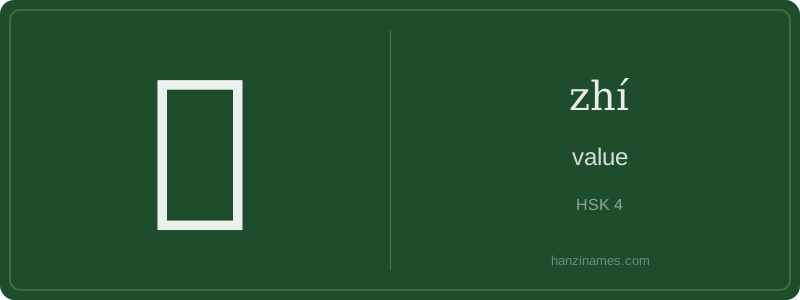
值 is ubiquitous in modern Mandarin: used in pricing (标价多少?这值吗?), labor discussions (加班值不值?), education (留学值不值得?), and digital life (这个APP值不值得下载?). It’s central to the high-frequency phrase 值得 (zhí de, 'worthwhile'), appearing in official surveys, news headlines, and HSK textbooks. Historically, 值 first appeared in bronze inscriptions of the Zhou dynasty as a phonosemantic compound meaning 'to stand in place' or 'to be stationed'—later extended metaphorically to 'to match' or 'to correspond to' (as in value equivalence), per the *Shuōwén Jiězì* (100 CE).
The character combines 亻 (person radical) and 直 (zhí, 'straight, direct'), indicating a person acting in alignment with truth or proportion—hence 'justified value'. Its modern meaning stabilized during the Han dynasty, reflecting growing commercial and ethical discourse on fairness in exchange and conduct.
The Chinese character 值 (zhí) fundamentally conveys the idea of 'value'—but not just monetary worth. It encompasses intrinsic worth, appropriateness, equivalence, and even moral significance. Unlike English 'value', which often defaults to economic or subjective judgment, 值 carries strong contextual weight: something is 值 only when it meets a measurable or socially accepted standard of fairness or utility—e.g., time well spent, effort justified, or price reasonable. This reflects Confucian-influenced pragmatism: value arises from relational balance, not abstract theory.
In Western thought—especially post-Enlightenment economics—'value' is often divorced from ethics and treated as quantifiable (labor theory, marginal utility). In contrast, 值 frequently appears in evaluative judgments tied to duty or consequence: 值得 (worthwhile) implies moral or practical justification, not just preference. A job may pay well but still not be 值得 if it harms health or integrity—a nuance rarely captured by English 'valuable' alone.
Culturally, 值 also anchors concepts of fairness and reciprocity in daily interactions. Saying 这不值 (this isn’t worth it) isn’t merely cost-benefit analysis—it signals a breach of expected balance, echoing traditional notions of 'right measure' (度, dù) found in Daoist and Legalist texts. Thus, 值 functions as both linguistic shorthand and cultural compass: it quietly enforces norms of proportionality, respect, and earned return—making it far richer than its dictionary definition suggests.
Example Sentences
Common Compounds
Similar Characters — Don't Mix These Up
Your First Step into Chinese Culture: Get a Chinese Name
Every journey into Chinese begins with a name. Use our free Chinese name generator to create a meaningful, personalized Chinese name that fits you perfectly.
Get My Chinese Name →