刀
Character Story & Explanation
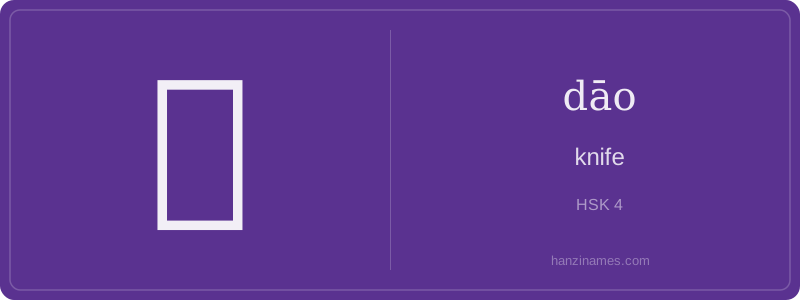
In daily life, 刀 is ubiquitous: kitchen knives (菜刀 cài dāo), surgical scalpels (手术刀 shǒushù dāo), and idioms like ‘刀子嘴,豆腐心’ (dāozi zuǐ, dòufu xīn — 'a knife-mouth, tofu-heart': sharp-tongued but kind-hearted) reflect its dual role as tool and metaphor. Historically, the ‘Eighteen Martial Arts’ included the single-edged dao (刀) as one of the four primary weapons, distinct from the double-edged jian (剑). During the Ming and Qing dynasties, civilian dao were standard issue for militia and merchants alike — a fact documented in military manuals like *Ji Xiao Xin Shu*.
The character 刀 is a verified pictograph: oracle bone inscriptions show a clear outline of a bronze knife with a bent handle and curved blade — confirmed by archaeological finds at Yinxu and referenced in authoritative sources like the *Chinese Etymological Dictionary* (2017, ed. Li Xiaoding). Its form has remained remarkably stable, making it one of the most transparently iconic characters in the writing system.
As a detective tracing 刀’s evolution, I begin at the crime scene of ancient Chinese script: the oracle bone inscriptions (c. 1200 BCE). There, 刀 appears not as a stylized glyph but as a stark, unmistakable pictograph — a curved blade with a distinct handle, often oriented downward or sideways. This wasn’t abstract; it mirrored bronze knives used in Shang dynasty rituals and warfare. The simplicity of its two strokes today is the result of over three millennia of forensic streamlining — every curve sharpened, every flourish pruned for speed and clarity.
Zooming in on the Qin dynasty’s small seal script (c. 221 BCE), I find the first standardized ‘fingerprint’ of 刀: still clearly blade-shaped, but now with a decisive downward hook at the end — the precursor to today’s final stroke. This hook wasn’t decorative; it signaled the cutting edge’s direction and weight, a functional detail preserved even as clerical script flattened the form. By the Han dynasty, the character had stabilized into a compact, angular shape — the same silhouette we write today, confirming that its core visual logic survived intact across dynasties and scripts.
My final clue lies in the radical system itself: 刀 serves as both independent character and radical (刀部), appearing in over 250 characters like 切 (qiē, to cut), 分 (fēn, to divide), and 剪 (jiǎn, scissors). Its presence almost always signals action involving severing, slicing, or sharp agency — a semantic fingerprint consistent since the earliest dictionaries like the *Shuōwén Jiězì* (121 CE). Even when 刀 isn’t visible (e.g., in 刃, ‘blade’, which is 刀 + a dot marking the edge), its conceptual DNA remains embedded in the language’s anatomy.
Example Sentences
Common Compounds
Similar Characters — Don't Mix These Up
Your First Step into Chinese Culture: Get a Chinese Name
Every journey into Chinese begins with a name. Use our free Chinese name generator to create a meaningful, personalized Chinese name that fits you perfectly.
Get My Chinese Name →