切
Character Story & Explanation
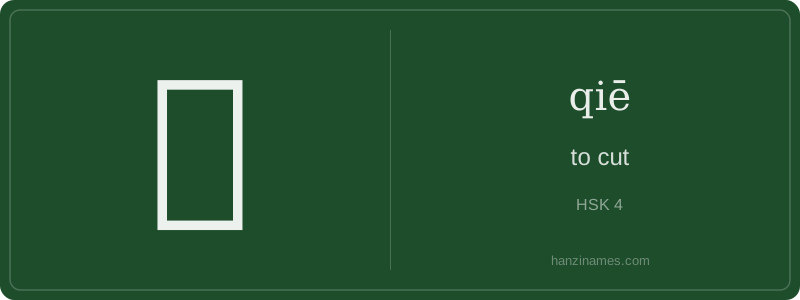
切 is widely used in daily life — from kitchen instructions ('切丝' qiē sī, 'julienne') to medical terms ('切除' qiēchú, 'surgical removal') and digital interfaces ('剪切' jiǎnqiē, 'cut' in copy-paste). It appears in the classical idiom 切磋琢磨 (qiēcuō zhuómó), originally describing stone- and jade-polishing, now meaning 'mutual learning and refinement'. This phrase dates back to the Book of Rites (Lǐjì, c. 3rd century BCE) and remains common in education contexts today.
The character 切 first appeared in seal script (c. 3rd century BCE) as a compound of 刀 (knife) and 七 (seven), likely indicating repeated, precise cutting — not a pictograph of a tool, but a semantic-phonetic structure where 刀 signals meaning and 七 approximates sound. Modern usage overwhelmingly centers on accuracy: whether chopping scallions or editing a video, 切 implies intentionality and control.
Hi students! Let’s learn 切 (qiē), a simple but powerful character with just four strokes and the knife radical 刀 — a clear visual clue that it’s about cutting. In everyday speech, 切 most commonly means 'to cut' or 'to slice', like slicing vegetables or trimming paper. It appears in many verbs and compounds, and its pronunciation changes depending on context: qiē for physical cutting, and qiè for abstract meanings like 'urgent' or 'deeply'. Don’t worry — we’ll practice both!
Notice how the left part is 刂 (the 'knife' radical, a variant of 刀), and the right part is 七 (qī, 'seven'). Though 七 isn’t phonetic here, this structure helps you remember the shape — think: 'a knife makes seven precise cuts'. The stroke order is vital: start with the horizontal stroke, then vertical, then the knife radical’s two strokes. Writing it correctly builds muscle memory for dozens of other characters with 刂.
This character bridges concrete action and rich abstraction. When used as qiè — like in 切实 (qièshí, 'practical') or 切题 (qiètí, 'on-topic') — it conveys precision, relevance, and earnestness. That shift from physical cutting to intellectual 'cutting to the core' reflects a beautiful pattern in Chinese: many action-based characters evolve into metaphors for clarity and truth. Mastering 切 gives you access not only to cooking vocabulary but also to academic, professional, and idiomatic language.
Example Sentences
Common Compounds
Similar Characters — Don't Mix These Up
Your First Step into Chinese Culture: Get a Chinese Name
Every journey into Chinese begins with a name. Use our free Chinese name generator to create a meaningful, personalized Chinese name that fits you perfectly.
Get My Chinese Name →