勺
Character Story & Explanation
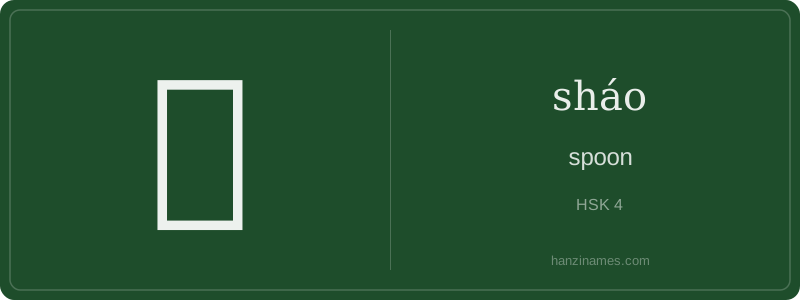
勺 is routinely used in cooking instructions, recipe books, and food packaging across China — for example, soy sauce bottles often list sodium content per '勺' (15 mL standard in nutrition labeling). It appears in the common phrase 一勺一勺地喂 (yī sháo yī sháo de wèi), meaning 'to feed spoonful by spoonful', frequently used in childcare or eldercare contexts. The idiom 勺子掉进锅里了 (sháozi diào jìn guō lǐ le) humorously means 'the spoon fell into the pot' — implying an unavoidable, slightly awkward but ultimately harmless mistake.
Archaeological evidence confirms that early forms of 勺 appeared as pictographs in Bronze Script (c. 11th century BCE), depicting a curved handle and bowl — unmistakably a spoon. The modern seal script simplified this into the current three-stroke structure: a curved stroke (勹) followed by two short strokes inside, retaining the essential silhouette of a ladle.
The Chinese character 勺 (sháo) is a deceptively simple yet culturally rich glyph representing a spoon — a utensil central to East Asian dining traditions. Unlike Western spoons, which vary widely in size and function (teaspoon, tablespoon, soup spoon), the Chinese 勺 typically refers to a medium-sized, shallow, often ceramic or stainless-steel spoon used for soups, rice, and communal serving. Its minimal three-stroke form reflects ancient calligraphic economy, prioritizing function over ornamentation.
Historically, the spoon predates chopsticks in China, with bronze spoons dating to the Shang Dynasty (c. 1600–1046 BCE). While Western cultures associate spoons with individual portions or dessert, the Chinese 勺 embodies collectivity: it’s commonly shared from a central bowl or used to ladle hotpot broth. This communal role mirrors Confucian values of harmony and shared sustenance — contrasting with the more individualistic, cutlery-specific norms in Europe and North America.
In modern Mandarin, 勺 extends metaphorically beyond utensils: it appears in measurements (e.g., 一勺盐 — 'a spoonful of salt'), idioms like 勺子打翻了 (colloquially meaning 'to blurt something out unintentionally'), and even internet slang (e.g., 勺音, a playful term for 'spoon sound', mimicking accidental mic feedback). Its radical 勹 (bāo), meaning 'to wrap' or 'enclose', subtly reinforces the spoon’s concave, cradling shape — a rare case where a radical visually echoes function across millennia.
Example Sentences
Common Compounds
Similar Characters — Don't Mix These Up
Your First Step into Chinese Culture: Get a Chinese Name
Every journey into Chinese begins with a name. Use our free Chinese name generator to create a meaningful, personalized Chinese name that fits you perfectly.
Get My Chinese Name →