区
Character Story & Explanation
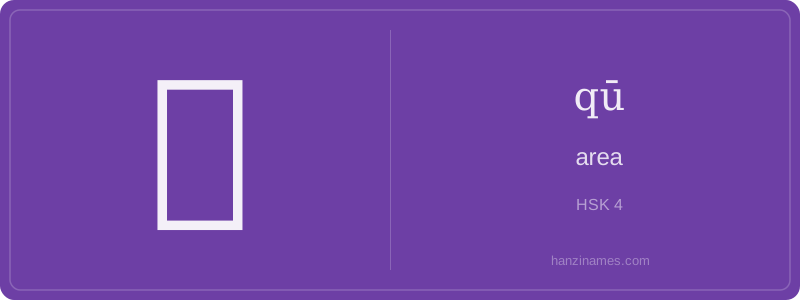
In contemporary China, 区 is ubiquitous in official usage: every prefecture-level city is divided into districts (市辖区), such as Guangzhou’s Tianhe District or Chengdu’s Wuhou District. It appears in legal documents, property deeds, and WeChat Pay location tags. The phrase ‘行政区划’ (xíngzhèng qūhuà, ‘administrative division’) is a standard term in state publications and census reports. It also features in common phrases like ‘开发区’ (kāifā qū, ‘development zone’)—a key driver of China’s economic reform since the 1980s.
The character 区 evolved from seal script forms depicting an enclosed space. Its earliest attested use appears in Han dynasty bamboo slips as a noun meaning ‘section’ or ‘division’. While not a pictograph of a physical object, its structure—enclosing 匚 (a variant of 匸) around ‘×’ (a simplified marker)—visually conveys containment and classification, consistent with its documented administrative function since at least the 3rd century BCE.
The character 区 (qū) is a deceptively simple four-stroke glyph that carries immense administrative and spatial weight in modern Chinese. Though it looks like a modest enclosure, it functions as the foundational unit for describing any bounded space—geographic, functional, or institutional. From Beijing’s Chaoyang District to Shanghai’s Pudong New Area, 区 appears on street signs, government documents, and subway maps, signaling jurisdictional boundaries and civic identity.
Historically, 区 emerged during the Qin–Han transition as a standardized administrative subdivision, replacing older feudal divisions. Its radical 匸 (xì), meaning 'to conceal' or 'to enclose', reflects its core semantic function: demarcating a defined, governed space. Unlike broader terms like 地区 (dìqū, 'region') or 地方 (dìfāng, 'place'), 区 implies formal designation—often with legal authority, service provision, and electoral representation.
In daily life, 区 anchors people’s sense of location and belonging. A Shenzhen resident says ‘I live in Nanshan District’ (我在南山区) not just to name a place—but to signal school zoning, hukou registration, and even pandemic response protocols. Its brevity (just four strokes) belies its systemic importance: it’s the smallest officially recognized territorial unit above the subdistrict (街道), making it indispensable in urban governance, real estate, and public services across China.
Example Sentences
Common Compounds
Similar Characters — Don't Mix These Up
Your First Step into Chinese Culture: Get a Chinese Name
Every journey into Chinese begins with a name. Use our free Chinese name generator to create a meaningful, personalized Chinese name that fits you perfectly.
Get My Chinese Name →