博
Character Story & Explanation
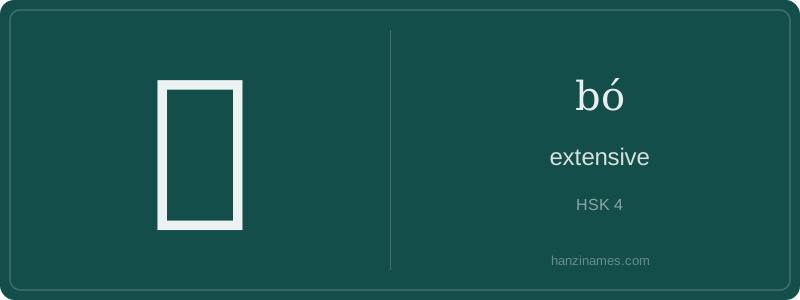
博 is ubiquitous in modern Chinese life: it appears in ‘博览会’ (bólǎn huì, trade fair/exhibition), ‘博士’ (bóshì, Ph.D.), and the national slogan ‘博爱’ (bó’ài, universal love), enshrined in Sun Yat-sen’s Three Principles. The idiom ‘博古通今’ (bó gǔ tōng jīn)—‘well-versed in both ancient and modern’—is still used to praise scholars and leaders. Historically, it appears in the *Book of Rites* (c. 3rd century BCE) describing virtuous rulers who ‘broadly investigate principles’ (博闻强识).
Graphically, 博 is a phono-semantic compound: left radical 十 (shí, ‘ten’) is a variant of 勹 (bāo, ‘to wrap’), historically linked to ‘spreading out’; right component 尃 (fū, now written as 甫) provides sound. Its earliest attested form appears in Warring States bamboo slips (4th c. BCE), already meaning ‘extensive’ and ‘to win over’—reflecting its dual sense of intellectual reach and persuasive influence.
The Chinese character 博 (bó) conveys richness—not just in quantity, but in depth and breadth of knowledge, resources, or experience. Unlike English ‘abundant’, which often emphasizes sheer volume, 博 carries an intellectual and ethical dimension: it implies cultivated, well-rounded abundance—like a scholar’s wide learning or a society’s inclusive prosperity. This reflects Confucian ideals where ‘broad learning’ (博学) is foundational to moral development.
In classical texts, 博 frequently appears in ethical-political contexts—e.g., the Analects (19.6) praises the junzi (gentleman) who is ‘broad in learning and restrained by ritual’ (博学于文,约之以礼). Here, ‘broad’ isn’t passive accumulation but disciplined, purposeful engagement with diverse fields—echoing Western humanist ideals, yet rooted in relational ethics rather than individual achievement.
Compared to Western equivalents like ‘comprehensive’ (technical scope), ‘erudite’ (scholarly depth), or ‘plentiful’ (material surplus), 博 uniquely fuses all three—while adding a quiet moral weight. It’s closer to the Renaissance ideal of the ‘universal man’, but without elitism: modern usage includes ‘博爱’ (universal love) and ‘博览会’ (exhibition), showing how 博 bridges wisdom, compassion, and public sharing—making it culturally resonant far beyond dictionary definitions.
Example Sentences
Common Compounds
Similar Characters — Don't Mix These Up
Your First Step into Chinese Culture: Get a Chinese Name
Every journey into Chinese begins with a name. Use our free Chinese name generator to create a meaningful, personalized Chinese name that fits you perfectly.
Get My Chinese Name →