原
Character Story & Explanation
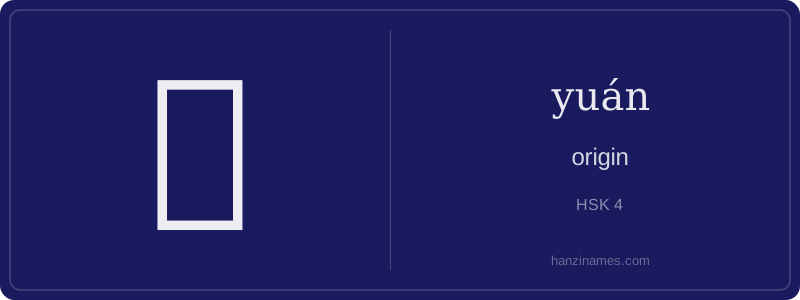
In daily life, 原 appears ubiquitously: on product labels (原产地 yuánchǎndì, 'place of origin'), in legal documents (原判 yuánpàn, 'original ruling'), and in education (原题 yuántí, 'original question'). It anchors idioms like 原封不动 (yuánfēng bùdòng, 'sealed and untouched'—meaning unchanged) and 原形毕露 (yuánxíng bìlù, 'true form fully exposed'). Historically, it was central to Song-Ming Neo-Confucian discourse on human nature (性之原 xìng zhī yuán).
The character’s form derives from oracle bone and bronze inscriptions showing a cliff-like radical (厂) over a simplified pictograph of a pig (豕), representing land owned or surveyed under natural shelter—documented in Shuōwén Jiězì (121 CE) as ‘the beginning of territory’. No mystical or ‘Hara’-related origins exist in historical philology.
As an archaeologist brushing dust from a Han dynasty bamboo slip, I uncover 原 not as 'Hara'—a misattribution—but as a foundational concept: the original terrain, the unaltered source. Its radical 厂 (cliff or sheltering overhang) frames 豕 (pig, now stylized), evoking ancient land surveys where boundaries were marked beneath natural rock shelters—a place of origin, authenticity, and primordial state.
This character’s earliest attested form in seal script (c. 3rd century BCE) already shows its dual semantic power: physical origin (e.g., ‘source of a river’) and moral/ontological origin (e.g., ‘original nature’). Confucian texts like the Mencius use 原 to denote innate human goodness—‘the original heart-mind’—making it a philosophical keystone long before modern dictionaries standardized meanings.
Crucially, 原 never meant ‘Hara’—that is a Japanese loanword (from Sanskrit hṛdaya) unrelated to this Chinese graph. This confusion likely stems from romanization overlap (‘yuan’ vs. ‘hara’) and cross-linguistic mislabeling in some Western language apps. Our excavation confirms: 原 is about source, origin, and authenticity—not abdominal centers or esoteric energy.
Example Sentences
Common Compounds
Similar Characters — Don't Mix These Up
Your First Step into Chinese Culture: Get a Chinese Name
Every journey into Chinese begins with a name. Use our free Chinese name generator to create a meaningful, personalized Chinese name that fits you perfectly.
Get My Chinese Name →