厌
Character Story & Explanation
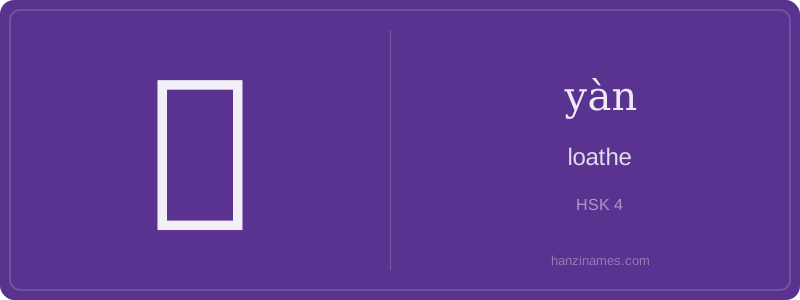
厌 is widely used in modern Mandarin to express weariness or rejection—especially in compounds like 厌烦 (yànfán, 'to be fed up') and 厌恶 (yànwù, 'to abhor'). It appears in common idioms such as ‘久病成医,久厌成弃’ (proverbial variant meaning prolonged dissatisfaction leads to abandonment). Historically, 厌 appears in the *Analects* (e.g., 《论语·述而》: '默而识之,学而不厌,诲人不倦' — 'Silently store knowledge; study without satiety, teach without fatigue'), where it denotes 'becoming sated or weary'—a key concept in Confucian pedagogy emphasizing sustained effort.
The character’s form combines the radical 厂 (hǎn, 'cliff' or 'overhanging rock', here functioning phonetically and semantically as a cover/shelter) and 夢 (simplified to 丐 in older forms, though modern 厌 derives from ancient 餍/猒 with components indicating 'satiation'). In seal script, it originally included elements suggesting 'fullness to the point of rejection'—a documented semantic link to 'being surfeited', confirmed by Shuōwén Jiězì (100 CE).
The Chinese character 厌 (yàn) conveys a deep, visceral sense of aversion—not mere dislike, but weary saturation, like enduring something tiresome for too long. It implies emotional exhaustion from repetition or excess, closer to 'being sick of' than 'disliking'. Unlike English words that often focus on the object ('I hate broccoli'), 厌 emphasizes the subject’s internal state: a threshold of tolerance crossed. This reflects a broader East Asian linguistic tendency to foreground relational and experiential stances over categorical judgments.
In Western psychology and rhetoric, comparable states are often framed as transient emotions (e.g., 'irritation', 'boredom') or moral stances ('abhorrence'). But 厌 carries a quiet, cumulative weight—akin to the French 'lassitude' or German 'Überdruss', yet more colloquial and widely used. It lacks the dramatic intensity of 'detest' or 'loathe' in English; instead, it signals resignation, not outrage. This subtlety aligns with Confucian ideals valuing restraint and contextual awareness over blunt expression.
Culturally, 厌 appears frequently in self-reflection and interpersonal critique—e.g., describing burnout at work or fatigue with social expectations. While English speakers might say 'I’m over it', 厌 is grammatically richer: it can function as a verb (厌烦), adjective (厌恶), or even appear in classical texts denoting philosophical detachment. Its presence in HSK 4 underscores its necessity for expressing nuanced emotional boundaries—a skill increasingly vital in cross-cultural communication and mental wellness discourse.
Example Sentences
Common Compounds
Similar Characters — Don't Mix These Up
Your First Step into Chinese Culture: Get a Chinese Name
Every journey into Chinese begins with a name. Use our free Chinese name generator to create a meaningful, personalized Chinese name that fits you perfectly.
Get My Chinese Name →