厉
Character Story & Explanation
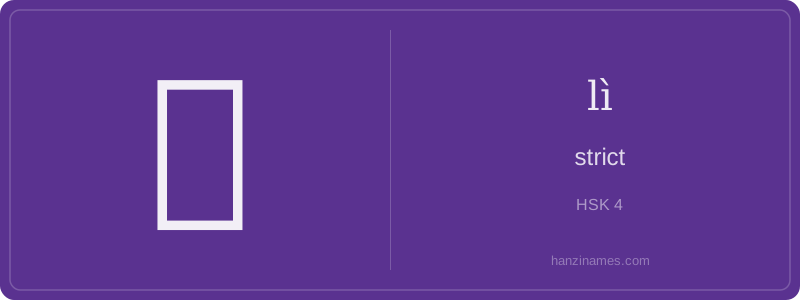
In daily Chinese, 厉 appears most frequently in compound words denoting intensity or rigor: 严厉 (yánlì, 'strict'), 厉害 (lìhai, 'impressive/severe'), and 厉行 (lìxíng, 'to strictly carry out'). It features in official discourse (e.g., 严厉打击犯罪, 'severely crack down on crime') and everyday praise ('你太厉害了!'—'You’re amazing!'). Historically, it appears in pre-Qin texts like the *Zuo Zhuan*, describing ministers who 'administered law with stern clarity' (厉法而治).
The character’s earliest attested form is in seal script (c. 3rd century BCE), where it clearly combines 厂 (cliff/overhang) and 万 (wàn, originally a pictograph of a scythe or ritual staff—later simplified). Though not an oracle-bone character, its structure reflects ancient associations of elevated terrain (authority) and cutting precision (decisiveness). Today, Chinese learners practice it early (HSK 4) precisely because its minimal strokes encode maximal conceptual density.
Unearthing 厉 (lì) feels like brushing dust from a Zhou dynasty bronze inscription—its sharp, angular form echoes the austerity of early ritual law. The radical 厂 (hǎn), meaning 'cliff' or 'overhanging rock', frames the character with an implicit sense of looming authority—not arbitrary harshness, but the inescapable gravity of consequence. Ancient scribes used it to describe stern ministers and decisive punishments, where severity served cosmic order, not caprice.
This character’s five-stroke economy belies its semantic weight: the top stroke is a firm horizontal line—the ‘lid’ of discipline; the vertical hook (乚) descends like a gavel; and the final two strokes (丿 and 丶) suggest swift, unhesitating action. Unlike emotive characters rooted in heart or speech, 厉 emerges from spatial and structural metaphors: cliffs, boundaries, and calibrated force.
Its evolution reveals a subtle cultural calibration: while modern usage often implies ‘strict’ or ‘severe’, classical texts pair it with virtue—e.g., 厉行法治 (lìxíng fǎzhì, 'rigorously implement rule of law')—showing that strictness, in Confucian-legalist tradition, was never cruelty, but fidelity to principle. To read 厉 is to encounter a moral compass calibrated by consequence, not sentiment.
Example Sentences
Common Compounds
Similar Characters — Don't Mix These Up
Your First Step into Chinese Culture: Get a Chinese Name
Every journey into Chinese begins with a name. Use our free Chinese name generator to create a meaningful, personalized Chinese name that fits you perfectly.
Get My Chinese Name →