及
Character Story & Explanation
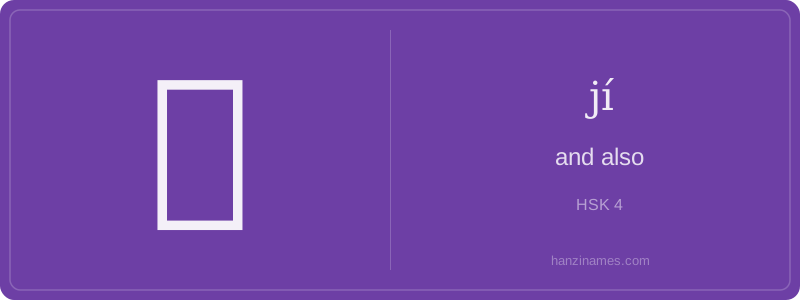
及 is widely used in formal and legal Chinese: e.g., in contracts ('甲方及乙方' — Party A and Party B), academic citations ('Zhang & Li, 2020, 及 others'), and bureaucratic notices. It appears in six of the top 100 most frequent HSK-4 vocabulary compounds, including 及时 (jíshí, 'in time') and 涉及 (shèjí, 'to involve'). A documented idiom is 过犹不及 (guò yóu bù jí, 'excess is as bad as deficiency'), from the Analects (11.16), illustrating its ancient philosophical weight.
Historically, 及 is a pictograph: oracle bone inscriptions show a hand (又 radical) reaching toward a person (人), evolving into today’s form. The original meaning was 'to reach, to catch up with'—still preserved in words like 来不及 (lái bu jí, 'too late to...'). Its semantic shift to 'and also' reflects grammaticalization: 'reaching to include' → 'including alongside'.
The character 及 (jí) is often introduced as meaning 'and', but this is a significant oversimplification. In classical and modern Chinese, it primarily functions as a conjunction meaning 'as well as', 'together with', or 'and also', emphasizing inclusion without equivalence—unlike English 'and', which typically implies equal weight between items. It carries a formal, slightly literary tone, appearing more in written than spoken contexts, such as official documents, academic writing, or idioms.
Western equivalents like the English 'and' or Latin 'et' suggest symmetry, but 及 subtly conveys hierarchy or sequence: the first element is primary, and the second is supplementary. Compare 'President and Vice President' (平等并列) versus 'President, as well as the Vice President' (主次分明)—the latter mirrors 及’s nuance. This reflects Confucian-influenced rhetorical values where order, deference, and contextual hierarchy matter linguistically.
In translation practice, mistaking 及 for simple 'and' can distort meaning. For example, 'A及B' usually means 'A, along with B'—not 'A and B' as co-equal subjects. Its usage aligns with East Asian relational thinking: identity is understood through connection and context, not isolated equivalence. Thus, 及 encodes cultural grammar—not just syntax—but how relationships are framed in Chinese thought.
Example Sentences
Common Compounds
Similar Characters — Don't Mix These Up
Your First Step into Chinese Culture: Get a Chinese Name
Every journey into Chinese begins with a name. Use our free Chinese name generator to create a meaningful, personalized Chinese name that fits you perfectly.
Get My Chinese Name →