反
Character Story & Explanation
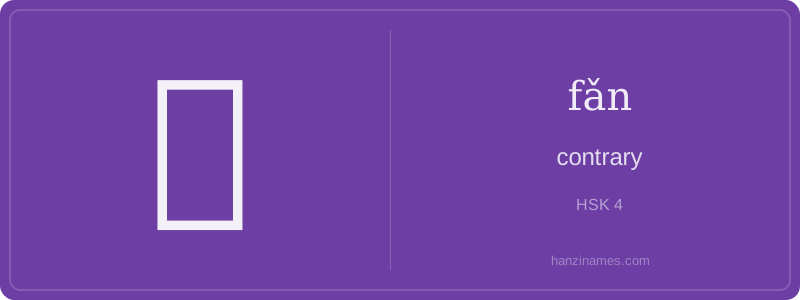
Historically, 反 appears in classical texts like the Book of Documents (Shūjīng) meaning 'rebellion'—e.g., '反叛' (fǎn pàn) documented in Warring States bamboo slips. Today, it’s ubiquitous: in news headlines (‘反腐败’—anti-corruption), tech terms (‘反应堆’—nuclear reactor), and daily speech (‘反而’—on the contrary). The idiom ‘举一反三’ (jǔ yī fǎn sān, 'from one example infer three') has been taught since the Han dynasty and remains core to Chinese pedagogy.
The character’s form lacks a verified pictograph origin. Modern scholarship (e.g., *Chinese Etymological Dictionary* by Schuessler) treats it as a phono-semantic compound with 又 (yòu) as both radical and phonetic hint. So instead of ancient imagery, consider this real-life scene: a teacher writes 反 on the board while correcting a student’s sentence—'你错了,应该反过来读' ('You’re wrong; read it backwards')—demonstrating its living, directional meaning.
As a linguistic detective, I begin with the oracle bone and bronze inscriptions—yet 反 leaves no clear pictographic trail. Unlike sun (日) or tree (木), it shows no object-based origin. Scholars like Karlgren and Li Xiaoding reconstruct it as a hand (又 radical) turning back, possibly from a verb meaning 'to turn over' or 'to invert'. Its earliest attestations in Western Zhou bronze texts already carry abstract meanings: reversal, opposition, rebellion—suggesting semantic abstraction occurred early.
The character’s four-stroke simplicity belies its conceptual weight. In seal script, 反 appears with a distinct curved stroke at the bottom, reinforcing motion backward; by clerical script, that curve straightens into the modern dot-and-hook shape. Crucially, 反 never meant ‘to oppose’ as a primary action—it implied inherent contradiction or inversion of state: a cup overturned, a direction reversed, a truth negated. This nuance persists in modern usage.
Its grammatical evolution is equally telling: 反 evolved from a full verb ('to turn back') into a prefix-like morpheme in compounds (e.g., 反对, 反应), and even functions as an adverb ('contrarily', as in 反而). This functional flexibility—spanning verb, noun, prefix, and adverb—makes it one of Mandarin’s most semantically dense characters. Its HSK Level 4 placement reflects not stroke count, but the subtlety required to grasp its contextual chameleon nature.
Example Sentences
Common Compounds
Similar Characters — Don't Mix These Up
Your First Step into Chinese Culture: Get a Chinese Name
Every journey into Chinese begins with a name. Use our free Chinese name generator to create a meaningful, personalized Chinese name that fits you perfectly.
Get My Chinese Name →