否
Character Story & Explanation
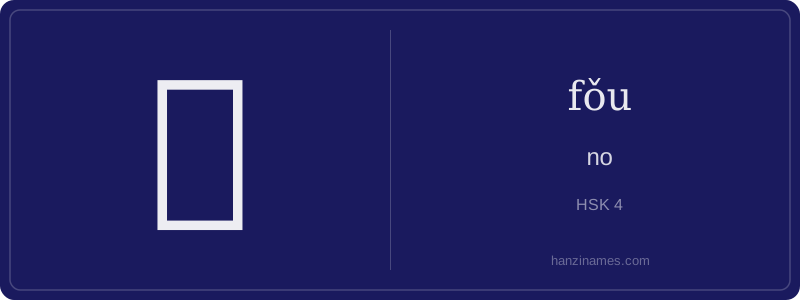
否 is routinely used in formal Mandarin for binary questions—especially in surveys, official documents, and academic writing—where it pairs with 是 (shì) to form the canonical ‘yes/no’ contrast. It appears in fixed phrases like ‘是否’ (shì fǒu, 'whether or not')—a cornerstone of indirect questioning in Chinese, reflecting cultural preference for politeness and face-saving. Historically, 否 appears in the Yijing as both a hexagram name and a lexical term meaning ‘obstruction’ or ‘rejection’, documented since the Warring States period (475–221 BCE).
The character’s form is not pictographic but phono-semantic: 口 (kǒu, ‘mouth’) is the semantic radical, indicating speech-related function, while the phonetic component 匚 (fāng, archaic variant of ‘box’ or ‘enclosure’) has evolved into the upper part 亠+不, though its original phonetic link to pǐ/fǒu is attested in ancient rhyme dictionaries like the Qieyun (601 CE). No oracle bone form survives; its earliest secure appearance is in bronze inscriptions from the late Zhou dynasty.
The character 否 (fǒu) embodies a foundational principle in Chinese thought: the necessity of negation not as mere rejection, but as an essential counterpart to affirmation—mirroring the yin-yang dynamic. In classical philosophy, especially in the Yijing (I Ching), 否 appears as Hexagram 12, symbolizing stagnation and obstruction, yet also signaling that such closure is cyclical and precedes renewal. This reflects a worldview where denial is never absolute, but relational and temporal.
Unlike English ‘no’, which often halts dialogue, 否 carries formal, almost ritual weight—used in classical texts, legal documents, and solemn oaths. Its presence signals deliberation: one doesn’t utter 否 lightly; it marks a conscious, often consequential reversal. This aligns with Confucian ideals of measured speech and Daoist acceptance of natural opposition—negation as part of cosmic balance, not defiance.
In modern Mandarin, 否 remains indispensable in written and formal spoken contexts—questions requiring yes/no answers, bureaucratic forms, scientific hypotheses, and rhetorical structures. Its persistence underscores how Chinese linguistic culture preserves philosophical depth in grammar: saying ‘no’ is not just refusal, but an act of positioning oneself within a web of relationships, duties, and cosmic rhythm. To use 否 well is to understand when silence, deference, or structured refusal serves harmony more than assent.
Example Sentences
Common Compounds
Similar Characters — Don't Mix These Up
Your First Step into Chinese Culture: Get a Chinese Name
Every journey into Chinese begins with a name. Use our free Chinese name generator to create a meaningful, personalized Chinese name that fits you perfectly.
Get My Chinese Name →