系
Character Story & Explanation
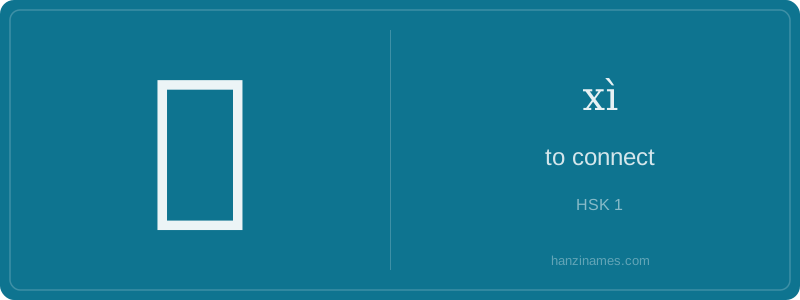
In contemporary China, 系 most commonly appears in academic and administrative contexts: university faculties (e.g., 数学系 shùxué xì, 'Department of Mathematics') and government agencies (e.g., 外交部国际司亚洲处系 wàijiāobù guójì sī yàzhōu chù xì, 'Asia Division, Department of International Affairs, Ministry of Foreign Affairs'). It also appears in fixed phrases like 关系 (guānxi, 'relationship/network') and 系统 (xìtǒng, 'system'), both HSK Level 4+ vocabulary. Historically, 系 appears over 300 times in the Mencius, consistently meaning 'to bind' or 'to be connected by principle'.
The character evolved from seal script, where 糸 (silk thread) formed the left component and the right side (the ‘jì’-pronounced variant) originally depicted hands tying a knot. By the Han dynasty, it standardized into its current form—seven strokes, with the radical 糸 clearly visible on the left. No oracle bone form survives, but bronze inscriptions from the Warring States period show early variants emphasizing binding action.
As an archaeologist brushing dust from a Han dynasty bamboo slip, I find 系 inscribed in elegant clerical script—its seven strokes revealing a quiet truth: this character was never just about knots or threads. The radical 糸 (silk thread) anchors it in material culture, yet early texts like the Shuōwén Jiězì (121 CE) define it as ‘to bind, to connect, to be related’—a semantic bridge between physical linkage and abstract affiliation. Its structure whispers of ancient bureaucracy: threads tied to denote lineage, duty, or institutional belonging.
The dual pronunciation xì/jì is not error but stratigraphy: xì dominates in formal, abstract usage (‘system’, ‘faculty’), while jì survives only in the fossilized verb ‘to tie’ (e.g., jì dài—‘to fasten a belt’). This phonetic split mirrors linguistic layering—like finding bronze inscriptions beneath later inked manuscripts. The character’s resilience lies in its duality: concrete action (tying) and abstract structure (system) coexist in one glyph.
Excavating modern usage, I see 系 still functioning as an administrative ligament—binding students to departments, data to networks, ideas to schools of thought. It appears on university building signs (‘Computer Science Department’), in legal documents (‘causal relationship’), and even in AI ethics discussions (‘ethical system interdependence’). Far from archaic, 系 is the silent syntax holding Chinese institutional and relational logic together—a lexical tendon, tested across two millennia.
Example Sentences
Common Compounds
Similar Characters — Don't Mix These Up
Your First Step into Chinese Culture: Get a Chinese Name
Every journey into Chinese begins with a name. Use our free Chinese name generator to create a meaningful, personalized Chinese name that fits you perfectly.
Get My Chinese Name →