候
Character Story & Explanation
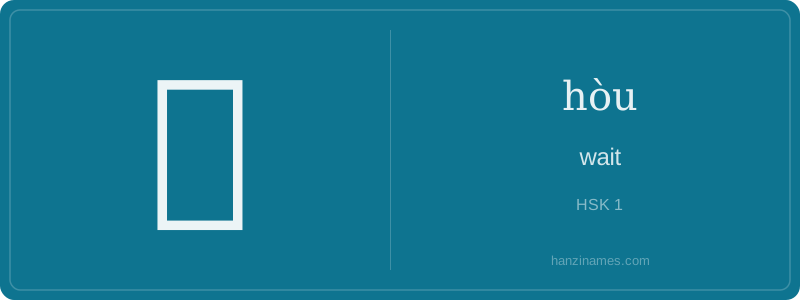
In daily life, 候 appears ubiquitously in time-related compounds: 天气预报中的‘候报’ (meteorological ‘hou-bao’, i.e., ten-day forecast), railway station announcements like ‘请等候’ (qǐng hòu hòu—‘please wait’), and classical idioms such as ‘时不我待’ (time waits for no one), where 候 subtly echoes in the urgency of temporal awareness. Historically, it was central to the ancient Chinese ‘24 solar terms’ system—each term divided into three 5-day 候 (‘hou’), totaling 72 climatic periods per year, documented since the Warring States period (475–221 BCE).
The character’s form derives from the seal script variant of 侯 (hóu, ‘marquis’), which itself combined 亻 + 矢 (arrow) + (enclosure), originally depicting a noble overseeing border watch. Over time, 候 specialized to mean ‘to observe/wait for signs’—a semantic narrowing attested in Shuōwén Jiězì (121 CE), China’s first dictionary, which defines it as ‘waiting for signals, observing seasons.’
As an archaeologist brushing dust from a Han dynasty bamboo slip, I find 候 inscribed in clerical script—not as a static glyph, but as a living record of temporal awareness. Its left radical 亻 (person) anchors it in human experience, while the right component 侯—originally a noble title—evolved to denote observation and anticipation. This duality reveals how early Chinese linked social roles with timekeeping: officials ‘waited’ for seasonal signs to advise rulers, turning vigilance into governance.
Excavations at Dunhuang caves uncovered Tang manuscripts where 候 appears in agricultural almanacs—‘frost候’, ‘rain候’—marking phenological thresholds. Here, 候 wasn’t abstract time, but embodied condition: the precise moment when mulberry leaves soften or geese migrate south. It’s a semantic fossil preserving how pre-modern China measured time not by clocks, but by biological and meteorological cues witnessed by people.
Unlike Western linear time, 候 encodes relational temporality: ‘waiting’ implies agency; ‘season’ implies cyclical recurrence; ‘condition’ implies contingency. The character’s 10-stroke structure—beginning with the person radical—signals that time is always interpreted *by* and *for* humans. Even today, when a Beijing resident checks ‘weather候’, they’re echoing millennia of observational practice encoded in this single, unassuming graph.
Example Sentences
Common Compounds
Similar Characters — Don't Mix These Up
Your First Step into Chinese Culture: Get a Chinese Name
Every journey into Chinese begins with a name. Use our free Chinese name generator to create a meaningful, personalized Chinese name that fits you perfectly.
Get My Chinese Name →