咳
Character Story & Explanation
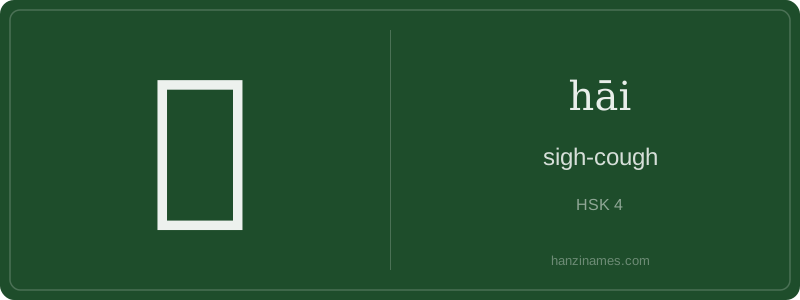
咳 is widely used in spoken Mandarin as an interjection (hāi) to express mild disapproval, impatience, or wry amusement—e.g., when someone makes an obvious mistake, a listener may say '咳…' before gently correcting them. Historically, it appears in Ming-Qing vernacular fiction (e.g., Water Margin) as a stage-direction-like cue for vocal hesitation or emotional restraint. It’s also common in modern dialogue scripts and subtitles to convey subtext without explicit wording.
The character is a phono-semantic compound: 口 (mouth radical) signals speech/sound, while 亥 (hài, the 12th Earthly Branch, here serving phonetically) hints at pronunciation. Though 亥 originally meant ‘pig’ in oracle bones, its use here is purely phonetic—no pictographic link to coughing exists. Its form has remained stable since seal script (c. 3rd century BCE), confirming its long-standing role as a lexicalized vocal gesture.
咳 (hāi/ké) is more than a cough—it’s a linguistic sigh, a breath made audible. In Chinese worldview, the body and emotion are inseparable; a sudden 'hāi' isn’t just air escaping lungs—it’s the sound of resignation, impatience, or gentle rebuke. Unlike English, where sighs are often non-lexical, Chinese elevates this vocalization to a written character—affirming that even fleeting, embodied expressions deserve lexical dignity and cultural attention.
This reflects the Confucian and Daoist appreciation for subtle, embodied communication: what isn’t said outright may be signaled through tone, pause, or a well-timed 咳. It embodies *yin* resonance—soft, internal, relational—where meaning lives not only in words but in the breath between them. The mouth radical (口) anchors it in speech, yet its dual pronunciation (hāi for expressive sighing, ké for pathological coughing) reveals language’s layered responsiveness to context and intention.
In daily interaction, 咳 functions as pragmatic punctuation—like clearing one’s throat before dissent, or softening criticism with audible hesitation. It mirrors the cultural preference for indirectness and face-saving: rather than bluntly saying 'I disagree', a teacher might utter 咳… then rephrase. Thus, this tiny nine-stroke character carries weight far beyond phonetics—it’s a microcosm of Chinese communicative ethics, where breath, voice, and social harmony intertwine.
Example Sentences
Common Compounds
Similar Characters — Don't Mix These Up
Your First Step into Chinese Culture: Get a Chinese Name
Every journey into Chinese begins with a name. Use our free Chinese name generator to create a meaningful, personalized Chinese name that fits you perfectly.
Get My Chinese Name →