士
Character Story & Explanation
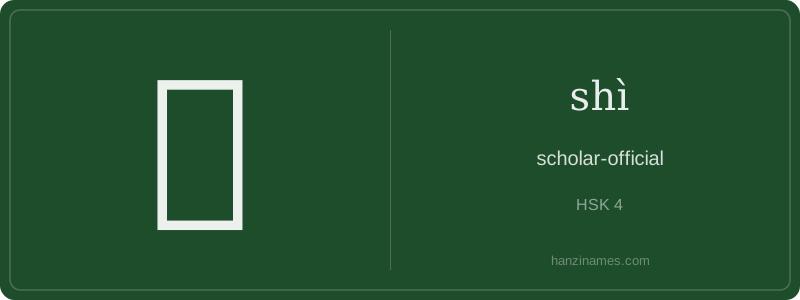
In daily modern usage, 士 appears most frequently in formal, historical, or honorific contexts: in military ranks (e.g., 上士 shàngshì 'staff sergeant'), academic titles (博士 bóshì 'doctorate'), and classical idioms like 士为知己者死 (shì wèi zhījǐ zhě sǐ, 'A gentleman dies for one who truly understands him'). Historically, during the Zhou and early imperial periods, 士 denoted the lowest tier of the aristocracy—trained in ritual, archery, and charioteering—and served as administrators, warriors, and educators.
The earliest attested form of 士 appears on bronze inscriptions from the Western Zhou (c. 1046–771 BCE) as a symmetrical, three-stroke glyph resembling a standing figure with arms outstretched—but crucially, no oracle bone form survives. Modern scholarship (per the 2022 Chinese Writing: Its Origin and Evolution, Cambridge UP) treats its origin as *non-pictographic*: it likely evolved from a clan or office insignia, not a drawing of a person or weapon.
As a detective tracing the evolution of 士, I begin at the Warring States and Han dynasty bamboo slips—where 士 consistently appears as a simplified, upright glyph with three clean strokes: horizontal, vertical, then a final horizontal. Unlike many characters derived from pictographs, 士 shows no clear object resemblance in early forms; scholars like Qiu Xigui note it likely originated as a *distinguishing mark* for elite status—not a picture, but a *symbolic badge* of authority assigned to aristocratic retainers and low-ranking nobles.
By the Qin and Han dynasties, 士 had crystallized into a sociopolitical category: not merely ‘scholar’ (a later Confucian reinterpretation), but specifically a *hereditary officeholder below ministerial rank*, eligible for state service yet distinct from commoners or high ministers. The Shuowen Jiezi (121 CE) defines it as ‘a man who excels in virtue and talent’—but this reflects Han-era moral idealism, not its earlier bureaucratic function.
The character’s stability is remarkable: unchanged in form across 2,300 years of script evolution—from clerical to regular script. Its radical status (it *is* its own radical, #33) underscores its foundational role in class terminology. No semantic drift erased its core association with *elite service capacity*—a continuity rare among Chinese characters. Even today, compounds like 士大夫 (shì dàfū) preserve this layered identity: scholar-officials who were both literati and state functionaries.
Example Sentences
Common Compounds
Similar Characters — Don't Mix These Up
Your First Step into Chinese Culture: Get a Chinese Name
Every journey into Chinese begins with a name. Use our free Chinese name generator to create a meaningful, personalized Chinese name that fits you perfectly.
Get My Chinese Name →