够
Character Story & Explanation
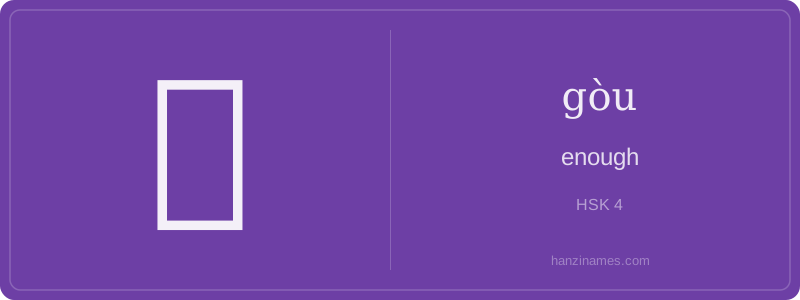
够 is widely used in modern Mandarin speech and writing at all levels — especially in spoken discourse where it replaces more formal synonyms like 足够 (zúgòu). Common phrases include 够了 (gòu le, 'That’s enough!'), 不够 (bùgòu, 'not enough'), and 够用 (gòu yòng, 'sufficient for use'). It appears in the HSK 4 vocabulary list and is frequent in everyday exchanges, such as bargaining ('这个价格够低吗?' — 'Is this price low enough?') or expressing limits ('我累够了' — 'I’m utterly exhausted').
The character 够 evolved from the older form 够 (a variant of 夠), first attested in Ming–Qing vernacular literature. Its current simplified form retains the 夕 (xī, 'evening') radical — historically linked to phonetic function rather than meaning — and the 句 (jù) component, originally a phonetic indicator. Though not pictographic, its structure reflects standard phono-semantic compounding common in later Chinese characters.
够 (gòu) is a fundamental Chinese character meaning 'enough' — not merely quantitative sufficiency, but often implying adequacy for purpose, emotional satisfaction, or pragmatic acceptability. Unlike English 'enough', which can carry neutral or negative connotations ('I’ve had enough!'), 够 frequently appears in affirmative, functional contexts: 'Is it enough?' (够了吗?), 'That’s enough' (够了), or 'Not enough' (不够). It’s deeply embedded in daily pragmatics — from ordering food to evaluating effort.
In Chinese philosophy and social communication, 够 reflects the Confucian-influenced value of moderation (中庸 zhōngyōng) — avoiding excess or deficiency. This aligns with the concept of 'just right', similar to the Western idea of the 'Goldilocks zone', but grounded in relational harmony rather than scientific precision. A person might say 我够用了 (wǒ gòu yòng le) — 'I have enough (for my needs)' — signaling contentment without boastfulness, a culturally valued restraint.
Western equivalents like 'enough', 'sufficient', or 'adequate' differ subtly: 'sufficient' sounds bureaucratic; 'adequate' often implies minimal acceptability, sometimes with faint disappointment. 够, by contrast, can be warmly affirming — as in 够朋友 (gòu péngyou), literally 'enough friend', meaning 'truly worthy of friendship'. This idiomatic use shows how 够 extends beyond quantity into moral and relational sufficiency — a nuance rarely captured in direct translation.
Example Sentences
Common Compounds
Similar Characters — Don't Mix These Up
Your First Step into Chinese Culture: Get a Chinese Name
Every journey into Chinese begins with a name. Use our free Chinese name generator to create a meaningful, personalized Chinese name that fits you perfectly.
Get My Chinese Name →