导
Character Story & Explanation
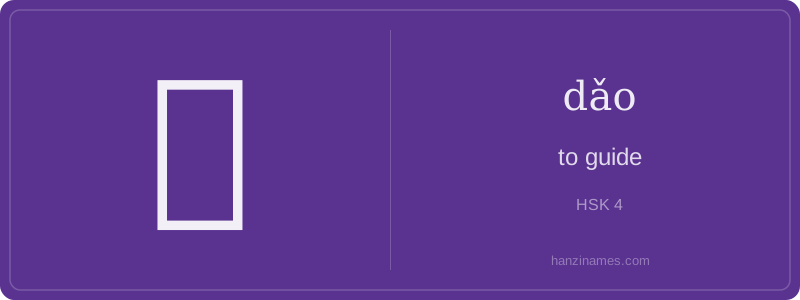
In daily life, 导 is ubiquitous in public infrastructure and education: ‘导乘’ (dǎo chéng) appears on subway signage nationwide; ‘导师’ (dǎo shī, academic advisor) is a formal university role mandated by China’s Ministry of Education; and ‘导游’ (dǎo yóu, tour guide) is a licensed profession regulated since 1999. The phrase ‘因势利导’ (yīn shì lì dǎo, ‘guide according to circumstances’) originates from the *Records of the Grand Historian* and remains common in policy speeches and management training.
The character 导 evolved from seal script, combining ‘寸’ (cùn, unit of measurement/rule, indicating control) and ‘道’ (dào, path/way, later simplified to ‘巳’ in modern form). While its oracle-bone origins are unattested, the documented seal-script form clearly signals ‘directing along a path’ — emphasizing guided movement rather than mere indication.
Imagine standing in Beijing’s bustling Xidan subway station, where a digital screen flashes ‘请导乘至1号线’ — ‘Please follow the guidance to Line 1’. Here, 导 (dǎo) isn’t abstract: it’s the gentle nudge of a staff member pointing toward escalators, the animated arrow on a touchscreen map, the recorded voice saying ‘请导乘’ — all actively transmitting direction, not just giving it. This character embodies purposeful, dynamic transmission — like a conduit channeling information from system to person.
Historically, 导 appears early in classical texts like the *Zuo Zhuan*, where it meant ‘to lead troops’ or ‘to guide ritual procedures’ — always implying intentional, authoritative transmission of order or knowledge. Its semantic core isn’t passive showing, but active facilitation: bridging gaps between source and receiver, whether in military strategy, education, or modern UX design.
In contemporary Mandarin, 导 carries layered nuance: it implies responsibility (a teacher 导学生), intentionality (a GPS 导航), and structural support (a conductor 导电). Unlike generic ‘show’ verbs like 指, 导 suggests a designed, reliable flow — like electricity through a wire or instructions through an app. That’s why it’s essential for HSK 4 learners: mastering 导 unlocks precise expression of mediation, instruction, and systemic transmission in real-world contexts.
Example Sentences
Common Compounds
Similar Characters — Don't Mix These Up
Your First Step into Chinese Culture: Get a Chinese Name
Every journey into Chinese begins with a name. Use our free Chinese name generator to create a meaningful, personalized Chinese name that fits you perfectly.
Get My Chinese Name →