广
Character Story & Explanation
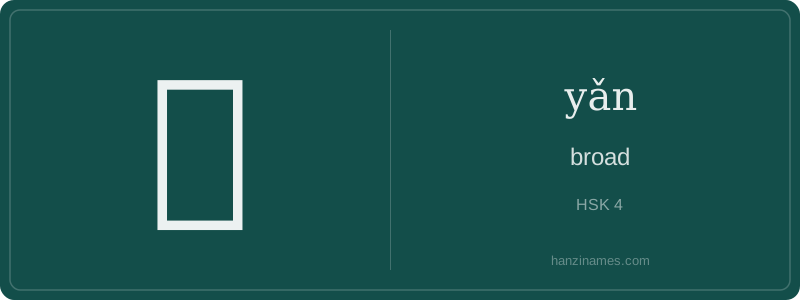
The character 广 (guǎng) has been used continuously since the Han dynasty (206 BCE–220 CE) in meanings like 'broad', 'extensive', and 'public'. Today, it’s ubiquitous: 广播 (guǎngbō, radio broadcast), 广场 (guǎngchǎng, public square), and 广告 (guǎnggào, advertisement) appear on signs, apps, and news headlines across China. The Beijing Tian’anmen Square (天安门广场) is perhaps the world’s most famous example — a literal ‘public open space’.
Historically, 广 evolved from a bronze script pictograph resembling a cliff-side shelter — an open structure built into a slope. Archaeological inscriptions confirm its early use to denote ‘spacious area’ or ‘covered place’. This meaning directly explains why it appears in characters for ‘shop’ (店), ‘sequence’ (序, originally a veranda where rituals unfolded), and ‘base/bottom’ (底, the lowest part under a structure).
Hello students! Today we’re learning the character 广 (guǎng), which is also read as yǎn when it appears as a radical — not as a standalone word. Don’t worry: you’ll almost always say ‘guǎng’ in real speech (e.g., 广告 guǎnggào = advertisement). As a radical, 广 is one of the most common left-side or top-left components, like a roof over a space — symbolizing openness or coverage. It’s simple: just three strokes, and it looks like an open doorway or shelter.
This radical appears in dozens of important characters, especially those related to places, spaces, or functions tied to buildings or locations — think 店 (diàn, shop), 序 (xù, sequence/order), 底 (dǐ, bottom/base), and 应 (yìng, to respond). Notice how each contains that same open-roof shape? That’s your visual anchor. Mastering 广 helps you recognize and remember many HSK-level 4+ words quickly.
Although 广 is listed as having two pronunciations, yǎn is *only* used when naming the radical itself — like in dictionary entries or calligraphy lessons. In daily life, you’ll never hear someone say ‘yǎn’ alone. So focus first on guǎng, and treat yǎn as a ‘teacher term’ for now. Its minimal stroke count (just 3!) makes it perfect for practicing correct stroke order: dot → horizontal → left-falling stroke — always from top to bottom, left to right.
Example Sentences
Common Compounds
Similar Characters — Don't Mix These Up
Your First Step into Chinese Culture: Get a Chinese Name
Every journey into Chinese begins with a name. Use our free Chinese name generator to create a meaningful, personalized Chinese name that fits you perfectly.
Get My Chinese Name →