序
Character Story & Explanation
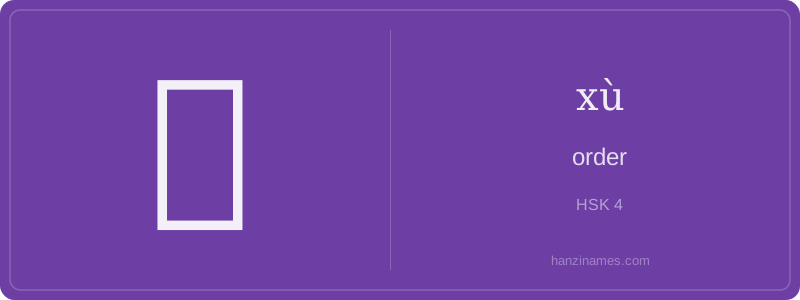
序 is routinely used in publishing, education, and administration across China and the Sinophone world. It appears in book prefaces (自序, zìxù — 'author’s preface'), official document numbering (如‘第一序’ for 'first in sequence'), and standardized testing rubrics (e.g., HSK test item sequences). A well-documented idiom is 井然有序 (jǐngrán yǒuxù), meaning 'neatly and orderly arranged'—frequently cited in government reports describing urban management or pandemic response logistics.
The character’s form combines 广 (yǎn, 'broad hall' radical, suggesting a space for assembly) with 予 (yǔ, 'to give'), historically indicating the act of assigning positions or roles within a structured setting. Though its earliest seal script form (c. 3rd century BCE) shows 广 + 予, scholars agree this reflects semantic-phonetic composition—not pictographic origins. Today, Chinese students memorize it as part of HSK 4 vocabulary, especially in contexts like course syllabi (教学序) and digital interfaces (排序, 'sort').
The Chinese character 序 (xù) conveys the fundamental concept of 'order' or 'sequence'—not merely numerical succession, but a culturally embedded principle of proper arrangement, hierarchy, and logical progression. In Confucian thought, this extends to social roles (e.g., elder before younger) and textual structure (e.g., prefaces introducing works). Unlike English 'order', which can imply command or tidiness, 序 emphasizes relational positioning and respectful chronology.
Western equivalents like 'sequence' (mathematical), 'order' (legal or culinary), or 'protocol' (diplomatic) are narrower in scope. 序 carries philosophical weight: it’s central to classical Chinese historiography (e.g., Sima Qian’s Records of the Grand Historian uses 序 to denote systematic arrangement of biographies) and literary tradition, where prefaces (序) frame meaning before the main text—a practice with no direct parallel in Western forewords, which rarely bear the same structural authority.
In modern usage, 序 appears in technical, academic, and bureaucratic contexts—'serial number' (序号), 'index' (目录序), or 'curriculum sequence' (课程顺序)—always implying a normative, intentional ordering. This reflects a broader East Asian cultural orientation toward harmonious structure over individualistic spontaneity. While Western logic often prioritizes cause-effect linearity, 序 embraces contextual sequencing: time, status, and function jointly determine rightful place.
Example Sentences
Common Compounds
Similar Characters — Don't Mix These Up
Your First Step into Chinese Culture: Get a Chinese Name
Every journey into Chinese begins with a name. Use our free Chinese name generator to create a meaningful, personalized Chinese name that fits you perfectly.
Get My Chinese Name →