底
Character Story & Explanation
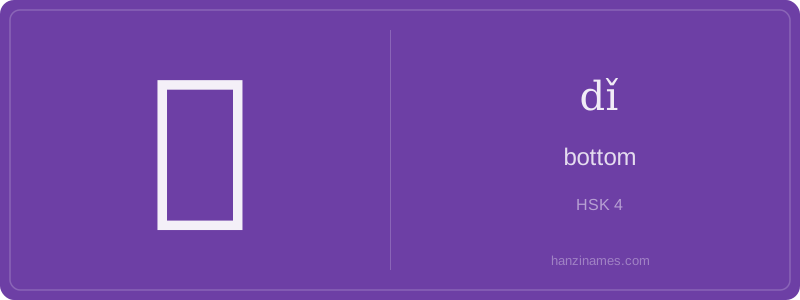
底 has been used since at least the Han dynasty (206 BCE–220 CE) in texts like the Shuōwén Jiězì (121 CE), where it’s defined as 'the lowest part of something' — confirming its core spatial meaning. Today, it appears in high-frequency phrases like 桌底下 (zhuō dǐxià, 'under the table'), 底线 (dǐxiàn, 'bottom line'), and in idioms such as 彻底 (chèdǐ, 'thoroughly' — lit. 'to the very bottom'). It’s also essential in legal and ethical discourse: 道德底线 (dàodé dǐxiàn) means 'moral bottom line', a widely cited concept in modern Chinese media and education.
The character’s form evolved from seal script, where it clearly combined 广 (a shelter or space marker) with 氐 (dī, an ancient variant meaning 'to press down' or 'base'). Unlike pictographs like 日 (sun), 底 isn’t a direct picture — but its structure visually conveys 'that which supports or lies beneath the covered space'. In daily life, Chinese speakers use 底 constantly — from telling kids 'don’t hide under the bed (床底下)' to discussing national policy 'red lines (红线) and bottom lines (底线)'.
Hi students! Let’s learn 底 (dǐ), a Level 4 HSK character meaning 'bottom' or 'base'. It’s not just about physical low positions — it’s deeply embedded in abstract ideas too, like 'foundation of knowledge' or 'the root cause'. Notice its radical 广 (guǎng), which often appears in characters related to space, shelter, or scope — think of it as a 'roof-like cover' over the concept of 'what lies beneath'. This helps you remember that 底 points to something foundational and underlying.
Though only 8 strokes, 底 is very practical: you’ll see it in everyday words like 桌子底下 (zhuōzi dǐxià — 'under the table') and in formal phrases like 有目共睹 (yǒu mù gòng dǔ — 'evident to all', literally 'seen by all eyes at the bottom'). Don’t confuse it with similar-looking characters — focus on its clear structure: 广 on top, then 低 without the 'person' radical (亻) — just the 'earth' (土) and 'low' (氐) parts fused together.
As a teacher, I encourage you to practice writing 底 slowly while saying 'dǐ' aloud — this builds muscle memory and pronunciation together. Try drawing it in the air first: start with the broad 'open roof' (广), then add the horizontal stroke, dot, and final descending stroke. Remember: in Chinese logic, the 'bottom' isn’t just location — it’s where things begin, rest, or are hidden. That’s why 底 appears in expressions about truth ('bottom line'), humility ('keeping a low profile'), and even internet slang (like 脸都不要了, literally 'not even keeping face at the bottom' = shameless!).
Example Sentences
Common Compounds
Similar Characters — Don't Mix These Up
Your First Step into Chinese Culture: Get a Chinese Name
Every journey into Chinese begins with a name. Use our free Chinese name generator to create a meaningful, personalized Chinese name that fits you perfectly.
Get My Chinese Name →