厨
Character Story & Explanation
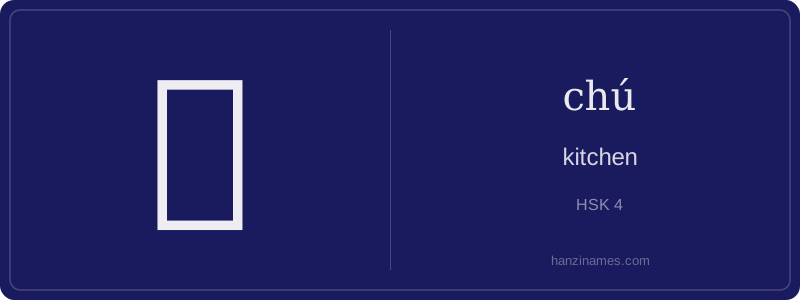
厨 is widely used in contemporary Chinese life — from apartment listings ('带独立厨', 'with independent kitchen') to restaurant menus ('厨神争霸', 'Cooking God Competition', a popular CCTV show since 2012). It appears in common terms like 厨房 (chúfáng, 'kitchen') and 厨师 (chúshī, 'chef'), and is central to HSK-4 vocabulary lists as a core noun for daily living spaces.
The character 厨 is not pictographic in origin; its earliest attested form appears in Han dynasty clerical script. Its left component 厂 (hǎn) is a radical meaning 'cliff' or 'overhang', historically used phonetically here, while the right side 尸 (shī) originally depicted a person crouching — later evolving into a phonetic element. Though not a true pictograph, modern learners associate the shape with a sheltered space (厂) where food work (尸 → stylized human activity) happens — mirroring real-life kitchen use today.
The Chinese character 厨 (chú) means 'kitchen' — but unlike the Western notion of a purely functional room for cooking, it carries connotations of culinary artistry, family nourishment, and social hospitality. In traditional Chinese homes, the kitchen was often the warm, bustling heart of domestic life, where generations gathered and values were passed down through shared meals.
In modern usage, 厨 extends beyond physical space: it appears in titles like 厨师 (chúshī, 'chef') and 厨艺 (chúyì, 'culinary skill'), highlighting respect for food preparation as a refined craft. This contrasts with many Western cultures, where 'kitchen' is increasingly associated with efficiency and appliances rather than artisanal mastery or intergenerational ritual.
Culturally, 厨 also evokes Confucian ideals of care and responsibility — feeding others is an act of virtue. In contrast, Western kitchens have historically reflected class divisions (e.g., hidden servant kitchens in Victorian homes) or, more recently, individualistic lifestyle branding (e.g., 'Instagram kitchens'). The character thus anchors food not just in utility, but in ethics, aesthetics, and relational warmth.
Example Sentences
Common Compounds
Similar Characters — Don't Mix These Up
Your First Step into Chinese Culture: Get a Chinese Name
Every journey into Chinese begins with a name. Use our free Chinese name generator to create a meaningful, personalized Chinese name that fits you perfectly.
Get My Chinese Name →