厅
Character Story & Explanation
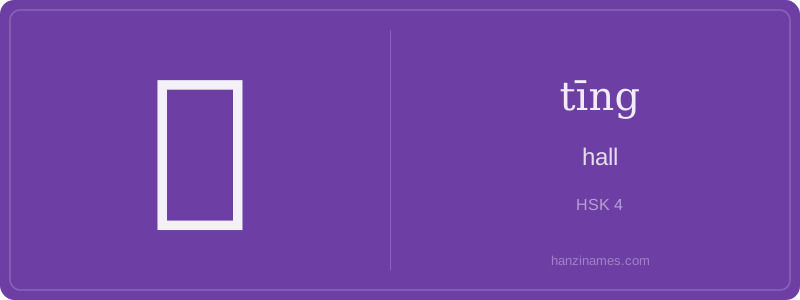
In modern Chinese life, 厅 is ubiquitous in official and domestic contexts: government offices use it in names like ‘公安局接待厅’ (Public Security Bureau Reception Hall), while apartments list ‘客厅’ (living room) on floor plans and rental ads. It appears in standardized terms like ‘会议厅’ (conference hall) and ‘候车厅’ (waiting hall) in train stations—terms codified in national standards (GB/T 16159–2012). Historically, Ming-Qing local gazetteers consistently employed 厅 to designate county-level administrative chambers, distinguishing them from magisterial ‘大堂’.
The character is not a pictograph—it evolved from seal script variants of 廳 (with 广 radical), simplified in 1956 to the current 厅. Its four-stroke form (一、丿、丨、一) reflects streamlined clerical script usage, not ancient imagery. Today, Chinese learners first encounter it in HSK 4 vocabulary lists and apartment listings—where ‘三室两厅’ (three bedrooms, two living rooms) is a nationwide real-estate shorthand.
As an archaeologist brushing dust from a Han dynasty bamboo slip, I find 厅 not etched in oracle bone but emerging later—its earliest secure attestations appear in clerical script inscriptions from the Eastern Han (25–220 CE). The character’s simplicity belies its functional weight: four strokes framing an open space under a roof-like radical 厂, evoking sheltered communal ground. Unlike older pictographs, 厅 was likely a semantic innovation—a ‘roofed gathering area’ coined as bureaucratic infrastructure expanded.
This character didn’t originate in ritual bronze inscriptions but in administrative documents—tax records, estate inventories, and local gazetteers where spatial designation mattered. Excavated slips from Juyan and Dunhuang repeatedly list ‘厅’ alongside ‘堂’, ‘室’, and ‘廊’, confirming its early role in denoting official reception spaces—not temples or palaces, but county yamen antechambers and magistrate’s audience halls. Its minimal stroke count reflects pragmatic scribal efficiency during rapid bureaucratic growth.
By the Tang dynasty, 厅 had solidified as the standard term for formal, semi-public interior spaces governed by function rather than hierarchy—distinct from the ancestral ‘堂’ (hall of reverence) or domestic ‘室’ (private room). Its enduring four-stroke form resisted simplification even in the 1956 reform, underscoring its lexical stability. Today, it stands as a quiet artifact of China’s administrative architecture—less a relic than a living unit of civic space, still stamped on government building plaques and real-estate floor plans across the Sinosphere.
Example Sentences
Common Compounds
Similar Characters — Don't Mix These Up
Your First Step into Chinese Culture: Get a Chinese Name
Every journey into Chinese begins with a name. Use our free Chinese name generator to create a meaningful, personalized Chinese name that fits you perfectly.
Get My Chinese Name →