建
Character Story & Explanation
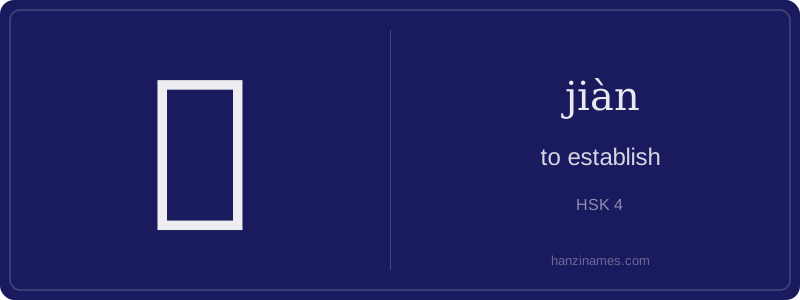
建 is ubiquitous in modern Chinese public life: it appears in official terms like 建国 (jiànguó, 'founding of the PRC' — used annually on National Day), 建党 (jiàndǎng, 'founding of the CCP'), and infrastructure projects like 建设新农村 (jiànshè xīn nóngcūn, 'building a new socialist countryside'). It’s central to the HSK 4 curriculum because learners must grasp its abstract, institutional sense — distinct from physical verbs like 盖 (gài, 'to cover/build') or 造 (zào, 'to make/construct').
The character’s earliest confirmed form (late Shang bronze script) shows 廴 + a hand-brush element, reflecting its origin in ritual inscription and administrative establishment. No oracle bone form survives definitively, but bronze inscriptions confirm its use by 10th century BCE rulers to denote founding rites and institutional appointments — verified by archaeological publications like the *Zhongguo Jinwen Jicheng* (2007).
Our detective begins at the crime scene: the character 建, first attested in bronze inscriptions of the Western Zhou dynasty (c. 1046–771 BCE). Its early form combines 廴 (yǐn), a radical meaning 'to advance slowly' or 'to proceed with purpose', and 聿 (yù), an ancient pictograph of a hand holding a brush — symbolizing deliberate, recorded action. This pairing already hints at intentionality: not just building walls, but establishing order through documentation and authority.
By the Qin and Han dynasties, the character stabilized into its modern structure: 廴 + 建’s upper component (originally 聿, later simplified to ⻍ + 一 + 口 in clerical script). Crucially, 建 never meant mere physical construction alone — it carried juridical and ritual weight. In imperial edicts, 建 was used for founding dynasties (e.g., 建漢 'establish the Han'), appointing officials ('to institute a post'), and setting calendrical systems — always implying legitimacy, precedent, and top-down authorization.
Today, 建 retains that authoritative nuance: you don’t ‘build’ a company — you 建立 one (jiànlì); you don’t ‘make’ a policy — you 建議 (jiànyì, ‘offer a formal proposal’). Its eight strokes are deceptively simple, yet each reinforces its core idea: purposeful initiation. The long horizontal stroke of 廴 signals forward motion; the compact upper part conveys decisive completion — like stamping a seal on a decree.
Example Sentences
Common Compounds
Similar Characters — Don't Mix These Up
Your First Step into Chinese Culture: Get a Chinese Name
Every journey into Chinese begins with a name. Use our free Chinese name generator to create a meaningful, personalized Chinese name that fits you perfectly.
Get My Chinese Name →