六
Character Story & Explanation
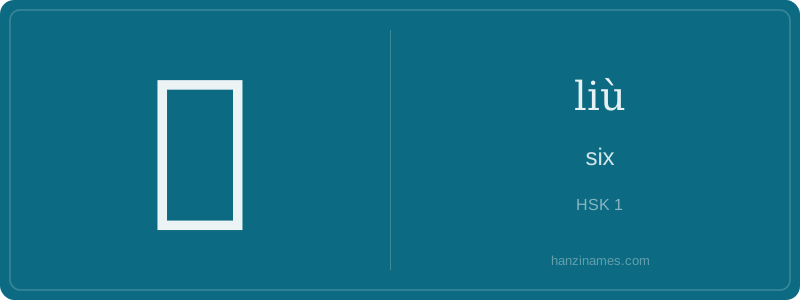
In daily life, 六 is ubiquitous: apartment numbers (e.g., 六楼 liù lóu, '6th floor'), phone digits, calendar dates (六月 liù yuè, 'June'), and the popular phrase 六六大顺 (liù liù dà shùn), meaning 'double six brings great smoothness'—a modern folk expression rooted in homophonic luck (liù sounds like 'flow' or 'smooth' in some southern dialects, and is widely embraced during Lunar New Year greetings and business openings).
The character’s earliest confirmed forms appear in Warring States bamboo slips and Han dynasty clerical inscriptions—not oracle bones—as a streamlined numeral. Its shape shows no pictographic origin (unlike 日 for 'sun'); instead, it emerged as a conventionalized tally symbol, likely derived from earlier knot- or notch-counting systems, later standardized under imperial script reforms.
Our detective work begins with the oracle bone script—though no definitive early form of 六 survives, scholars note that by the late Shang and Zhou dynasties, it appeared as a simplified, symmetrical glyph resembling two downward strokes flanking a central vertical or dot. Unlike numerals like 一 (one) or 二 (two), which are purely iconic, 六 evolved toward abstraction, shedding pictorial roots to prioritize writing speed and consistency across bronze inscriptions and seal scripts.
By the Qin dynasty’s standardized small seal script, 六 had stabilized into its core structure: a top dot or short horizontal, followed by a left-falling stroke (丿), then a right-falling stroke (㇏), and finally the radical 八 at the bottom—a component historically associated with ‘separation’ or ‘dividing’, possibly reflecting ancient counting practices where six was conceptualized as ‘two threes’ or ‘a pair split’. This structural logic helped distinguish it from similar numerals like 人 (rén, person) or 入 (rù, to enter).
The clerical script of the Han dynasty further flattened and squared the strokes, cementing the modern four-stroke form we recognize today. Its minimalism—just four clean strokes—made it exceptionally teachable, contributing to its inclusion in HSK Level 1. Crucially, 六 never developed semantic extensions beyond quantity; unlike 五 (wǔ, five) or 九 (jiǔ, nine), it carries no strong homophone-based auspicious or taboo connotations in standard Mandarin—making it a linguistic anchor of pure numerical function.
Example Sentences
Common Compounds
Similar Characters — Don't Mix These Up
Your First Step into Chinese Culture: Get a Chinese Name
Every journey into Chinese begins with a name. Use our free Chinese name generator to create a meaningful, personalized Chinese name that fits you perfectly.
Get My Chinese Name →