再
Character Story & Explanation
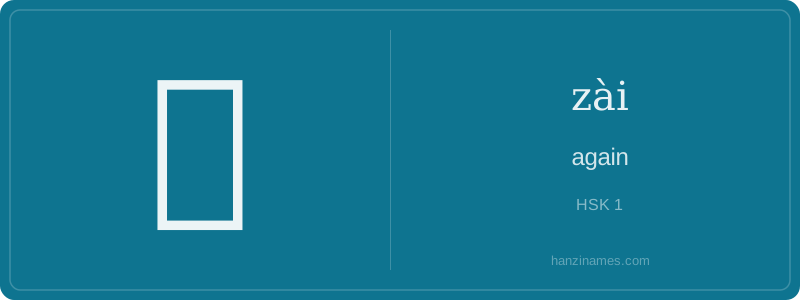
In daily life, 再 is indispensable for politeness and sequencing: ‘再见 (zàijiàn)’—literally ‘see again’—is China’s most universal farewell, documented as early as the Ming dynasty in vernacular fiction like *Jin Ping Mei*. It appears in legal texts (e.g., Tang Code) to denote repeated offenses (‘再犯’), and in modern education, HSK Level 1 learners encounter it first in phrases like ‘再来一次’ (try once more). It’s also central to the idiom ‘再接再厉’ (redouble one’s efforts), recorded in Han Yu’s 9th-century essay on cockfighting.
The character’s form has no pictographic origin—it’s a logical abstraction. The radical 冂 (jiōng) historically denotes enclosure or boundary; the two short horizontals above represent ‘two’, signaling duality or recurrence. No oracle bone glyph exists for 再; its earliest attestation is on Warring States bamboo slips, where it functions strictly as a temporal adverb.
As a linguistic detective, I begin with the oracle bone and bronze inscriptions—but here’s the twist: 再 doesn’t appear in earliest forms as a standalone character. Instead, it emerged later in the Warring States period (475–221 BCE) as a simplified, phonosemantic compound. Its structure—冂 (a ‘downward enclosure’ radical suggesting repetition or boundary-crossing) over two horizontal strokes—reflects an abstract notation for 'a second time', not a pictorial object. Scholars like Li Xiaoding note its early use in bamboo-slip texts to mark sequential actions, not physical objects.
The character’s six-stroke form stabilized during the Qin standardization of script (c. 220 BCE). The top two short horizontals originally represented ‘two’ (二), while 冂 evolved from 倝 (a variant of 丷 + 冂), implying ‘to pass through twice’. Unlike pictographs such as 日 (sun) or 木 (tree), 再 is purely schematic—its meaning arises from structural logic, not visual resemblance. This makes it one of Chinese writing’s earliest conceptual abstractions.
By the Han dynasty, 再 was firmly lexicalized as an adverb meaning ‘again’, appearing frequently in official documents and philosophical texts like the *Huainanzi*. Its grammatical role was precise: always pre-verbal, never nominal. Modern usage preserves this syntactic rigidity—unlike English ‘again’, which can float freely, 再 must directly precede the verb it modifies (e.g., 再说, not 说再). This constraint reveals how deeply its form and function co-evolved in classical syntax.
Example Sentences
Common Compounds
Similar Characters — Don't Mix These Up
Your First Step into Chinese Culture: Get a Chinese Name
Every journey into Chinese begins with a name. Use our free Chinese name generator to create a meaningful, personalized Chinese name that fits you perfectly.
Get My Chinese Name →