悉
Character Story & Explanation
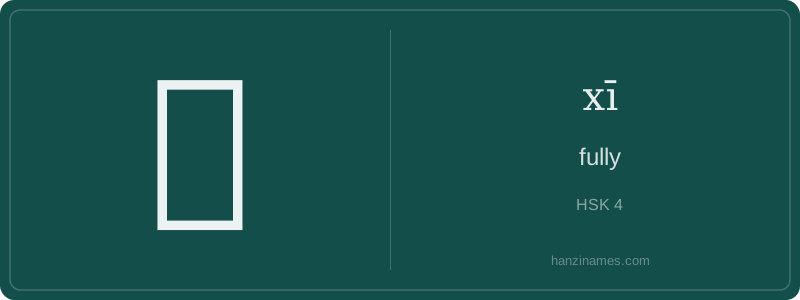
In modern Mandarin, 悉 appears primarily in formal, written contexts—official notices, academic writing, and set phrases like 悉知 (xī zhī, 'to be fully aware') and 悉数 (xī shù, 'in entirety'). It’s frequent in legal documents (e.g., '当事人悉知本条款'—'The parties are fully aware of these terms') and news headlines ('中方悉数回应'—'China responded comprehensively'). A well-documented idiom is 悉心照料 (xī xīn zhào liào), meaning 'to care for with utmost attention', used in medical and caregiving contexts since at least the Ming dynasty.
The character’s structure is historically clear: top 釆 (biàn, 'to distinguish by selection') + bottom 心 (xīn, 'heart/mind'). 釆 appears independently in oracle bone inscriptions as a hand picking ripe grain—symbolizing discernment. Combined with 心, it conveys 'mind that distinguishes completely'. No disputed origin: this semantic composition is confirmed in the Shuōwén Jiězì (121 CE), China’s earliest dictionary.
As an archaeologist brushing dust from a Han dynasty bamboo slip, I find 悉 inscribed in elegant clerical script—its 心 (heart) radical anchoring it not in emotion, but in cognitive completeness. The upper component, 釆 (biàn), originally depicted a hand selecting grains—a gesture of meticulous discernment. This isn’t mere ‘knowing’; it’s exhaustive comprehension, as if the heart itself has sifted every grain of truth.
Excavating further into Tang steles and Song printed sutras, 悉 appears consistently in formal registers: imperial edicts, Buddhist translations, and scholarly prefaces. Its eleven strokes encode a ritual of mental thoroughness—no detail left unexamined, no implication unweighed. Unlike colloquial 知 (to know), 悉 implies mastery achieved only after sustained, deliberate scrutiny—like an archaeologist cross-referencing stratigraphy, pottery shards, and carbon dates to reconstruct a vanished world.
This character resists casual use. In classical texts, 悉 often pairs with verbs like 闻 (to hear) or 知 (to know), forming compounds like 悉闻 (xī wén)—‘to hear in full detail’. Its presence signals authoritative, verified knowledge—not rumor or approximation. Even today, when a Chinese historian cites sources with 悉所周知, they invoke this ancient standard: truth validated through exhaustive inquiry, not assumed through familiarity.
Example Sentences
Common Compounds
Similar Characters — Don't Mix These Up
Your First Step into Chinese Culture: Get a Chinese Name
Every journey into Chinese begins with a name. Use our free Chinese name generator to create a meaningful, personalized Chinese name that fits you perfectly.
Get My Chinese Name →