悔
Character Story & Explanation
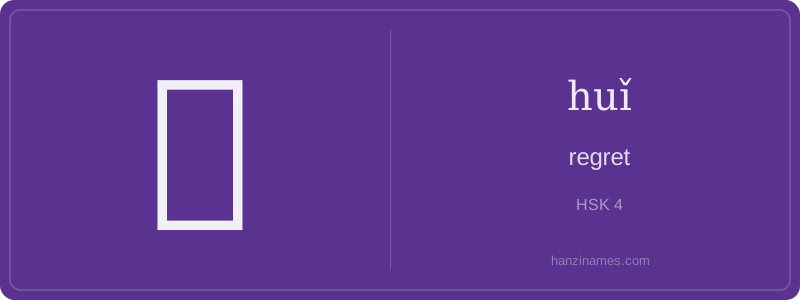
悔 appears frequently in modern Chinese media, education, and official discourse — especially in phrases like 深感后悔 (shēn gǎn hòuhuǐ, 'deeply regret') used in public apologies by officials or celebrities. It’s central to the idiom 后悔莫及 (hòuhuǐ mò jí, 'regret too late'), found in classical texts like the *Zuo Zhuan* (c. 4th century BCE), highlighting enduring cultural emphasis on timely reflection. The phrase is still taught in middle-school textbooks across China.
The character’s form evolved from seal script, where the right side 每 originally depicted a woman under a roof (a common ancient symbol for 'every' or 'repeated action'), while 忄 reinforced the emotional dimension. No oracle bone form survives, but by the Han dynasty (206 BCE–220 CE), 悔 was standardized with its current structure to express retrospective remorse.
Hi students! Today we’re learning 悔 (huǐ), a Level 4 HSK character meaning 'to regret' or 'to repent'. It’s a feeling word — emotional and deeply human. Notice its radical 忄 (the 'heart-mind' radical), which tells us this character is about inner feelings, not physical actions. That’s your first clue: when you see 忄, think emotions — joy, anger, sorrow, or regret!
This character has 10 strokes, and its structure is left–right: 忄 on the left (3 strokes), and 每 on the right (7 strokes). Don’t confuse 每 (měi, 'each') with 悔 — they look similar but mean very different things. Practice writing it slowly, paying attention to the dot-and-hook stroke in 忄 and the balanced 'umbrella' shape of 每.
In daily Chinese, 悔 isn’t just about small mistakes — it carries moral weight. You’ll hear it in serious contexts like apologies, self-reflection, or even legal confessions. It’s often paired with words like ‘deeply’ (深) or ‘sincerely’ (真), showing how strongly Chinese culture values honesty and accountability after wrongdoing.
Example Sentences
Common Compounds
Similar Characters — Don't Mix These Up
Your First Step into Chinese Culture: Get a Chinese Name
Every journey into Chinese begins with a name. Use our free Chinese name generator to create a meaningful, personalized Chinese name that fits you perfectly.
Get My Chinese Name →