惜
Character Story & Explanation
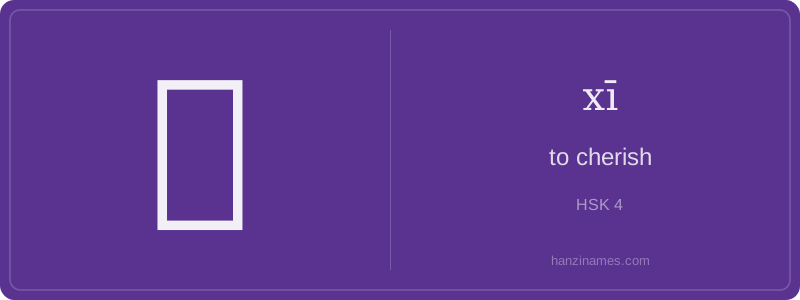
In modern Chinese, 惜 most commonly appears in set phrases like 惜才 (xī cái, 'to value talent')—used by educators and employers—and 惜别 (xī bié, 'to part with regret'), a staple in farewell letters and poetry. Historically, it appears in Tang dynasty poetry (e.g., Li Bai’s lines lamenting lost youth) and Confucian texts urging rulers to 惜民 (xī mín, 'cherish the people'). It’s central to the idiom 惜墨如金 (xī mò rú jīn, 'to spare ink like gold'), praising concise, precious writing.
The character’s form has no pictographic origin—it evolved from seal script as a phono-semantic compound. The right side 昔 was borrowed for sound and reinforced meaning: since 昔 means 'past', 惜 inherently suggests cherishing *because* something is passing or lost. Today, Chinese speakers use it earnestly in contexts demanding sincerity—e.g., parents telling children 不要惜力 (bù yào xī lì, 'don’t hold back effort')—implying deep investment in growth.
As a linguistic detective, I begin at the scene: the character 惜 appears in standardized seal script by the Qin dynasty (3rd c. BCE), already bearing its modern structure—no oracle bone or bronze inscriptions bear this exact form. Its left radical 忄 (heart/mind) signals emotional resonance, while the right component 昔 (xī) functions phonetically *and* semantically: 昔 originally meant 'past' (depicting sun 日 over dried meat 肉, evoking 'dried-up days'), implying something precious because it’s gone or fleeting—thus, to cherish what is impermanent.
The character’s design reflects classical Chinese philosophical sensitivity to transience—a core theme in Daoist and Buddhist thought. By Han dynasty texts like the Shuōwén Jiězì (121 CE), 惜 is explicitly defined as ‘to grieve over loss’ and ‘to value deeply’, confirming its dual emotional-intellectual weight. It never meant mere ‘like’ or ‘enjoy’; rather, it carried moral gravity—cherishing virtue, time, life, or relationships as ethical acts.
Unlike simpler emotive characters (e.g., 喜 ‘joy’), 惜 demands context: it’s rarely used alone in speech but thrives in compound verbs and literary expressions. Its eleven-stroke composition balances restraint and intention—each stroke deliberate, mirroring the mindfulness embedded in the concept itself. The third stroke of 忄 curves inward, subtly echoing the heart’s contraction in sorrow or care; the final dot of 昔 lands like a period—final, solemn, irrevocable.
Example Sentences
Common Compounds
Similar Characters — Don't Mix These Up
Your First Step into Chinese Culture: Get a Chinese Name
Every journey into Chinese begins with a name. Use our free Chinese name generator to create a meaningful, personalized Chinese name that fits you perfectly.
Get My Chinese Name →