恼
Character Story & Explanation
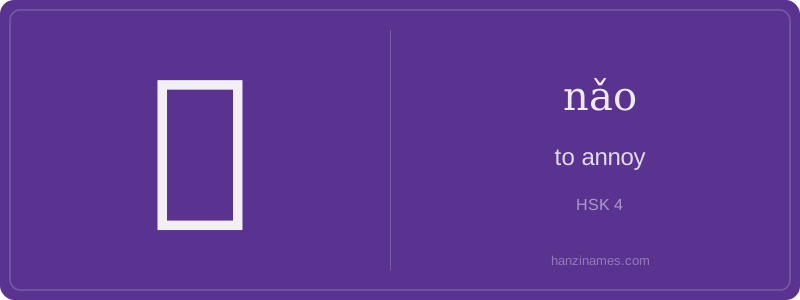
In modern Chinese, 恼 most commonly appears in compound words like 苦恼 (kǔnǎo, 'distress'), 烦恼 (fánnǎo, 'trouble/anxiety'), and 恼火 (nǎohuǒ, 'infuriating'). It’s rarely used alone as a verb in spoken Mandarin—instead, you’ll hear phrases like ‘真恼人’ (zhēn nǎorén, 'so annoying') or ‘别恼’ (bié nǎo, 'don’t get upset'). The HSK 4 frequency reflects its role in intermediate-level expressive nuance, especially in written contexts like essays or news commentary about social stressors.
The character evolved from seal script where the right component resembled ‘nao’ (brain), reinforcing its link to mental disturbance. While not a pictograph, its structure consistently signals emotional cognition—mind + agitation. Today, you’ll see it on Weibo posts lamenting work pressure ('加班让我很苦恼'), in counseling pamphlets, or in school textbooks teaching emotional vocabulary.
Imagine a bustling Beijing subway platform during rush hour—people packed shoulder-to-shoulder, air thick with humidity and impatience. Suddenly, a commuter’s phone rings loudly, disrupting the tense quiet. A woman nearby clenches her jaw, eyes narrowing as her breath quickens. That flicker of rising irritation—sharp, internal, emotionally charged—is precisely what 恼 (nǎo) captures: not explosive rage, but the simmering, personal discomfort of being provoked or frustrated.
Unlike more intense anger words like 怒 (nù) or 生气 (shēngqì), 恼 emphasizes mental disturbance—being vexed, annoyed, or mentally unsettled. It often implies self-contained emotional friction: you’re bothered *by* something, but your reaction may stay inward—tight lips, a sigh, or silent withdrawal. This subtlety makes it common in literature and daily speech when describing nuanced emotional states rather than outbursts.
The character’s left-side radical 忄 (heart/mind) signals its emotional domain, while the right side 腦 (nǎo, ‘brain’)—though simplified here to 勃 (bèi) in modern form—historically links to cognitive agitation. In classical usage, 恼 appeared in Buddhist texts (e.g., the *Avataṃsaka Sūtra*) to denote mental afflictions obstructing enlightenment—showing how deeply its meaning is tied to inner turmoil, not just outward anger.
Example Sentences
Common Compounds
Similar Characters — Don't Mix These Up
Your First Step into Chinese Culture: Get a Chinese Name
Every journey into Chinese begins with a name. Use our free Chinese name generator to create a meaningful, personalized Chinese name that fits you perfectly.
Get My Chinese Name →