愉
Character Story & Explanation
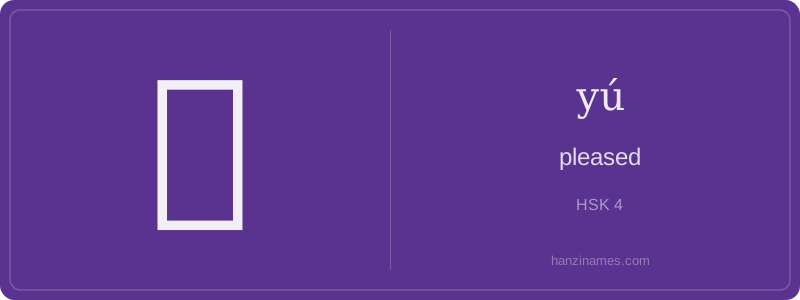
In modern Chinese, 愉 is most commonly encountered in formal and literary contexts: government announcements wish citizens ‘身心愉快’ (shēn xīn yú kuài, 'physical and mental well-being'), schools post banners urging students to ‘愉快学习’ (yúkuài xuéxí, 'learn with pleasure'), and health pamphlets advise ‘保持愉快心情’ (bǎochí yúkuài xīnqíng, 'maintain a pleasant mood'). The idiom ‘怡然自得’ (yírán zìdé)—often paired with 愉 in classical references—describes serene self-contentment, echoing Daoist and Confucian ideals of harmonious inner peace.
The character evolved from seal script (c. 3rd c. BCE), where its right side resembled 叔 (shū) as a phonetic component—no pictographic origin. Modern dictionaries (e.g.,《汉语大字典》) confirm it’s a phono-semantic compound: 忄 (heart, semantic) + 叔 (shū, phonetic). Today, Chinese people use 愉 daily in phrases like ‘愉快的周末’ (a pleasant weekend)—a staple in WeChat greetings and workplace emails.
The character 愉 (yú) embodies a quiet, heartfelt sense of pleasure—not the explosive joy of 大笑 (dàxiào, roaring laughter), but the warm, settled contentment you feel sipping jasmine tea on a sunlit balcony in Suzhou’s Pingjiang Road, watching elders play weiqi beneath willow trees. Its 忄 (heart) radical anchors it firmly in emotional experience, while the 叔 (shū) component—originally a phonetic hint—has no semantic link to ‘uncle’ here; it’s purely for sound. This is a feeling that lingers, not flashes.
At HSK Level 4, 愉 appears in nuanced emotional vocabulary where precision matters: not just ‘happy’, but ‘pleased’, ‘gratified’, or ‘serenely satisfied’. It’s the tone in a teacher’s voice when praising a student’s thoughtful essay—not ecstatic, but deeply appreciative. Unlike 快乐 (kuàilè, general happiness) or 高兴 (gāoxìng, cheerful excitement), 愉 carries literary weight and formal warmth, common in written Chinese, official letters, and classical-inspired expressions.
Its 12-stroke structure reflects careful balance: three heart-strokes on the left (忄), then nine strokes forming 叔—two horizontal lines, a vertical hook, and a compact ‘shu’ shape. Learners should practice the gentle curve of the final stroke in 叔, mirroring the softness of the emotion itself. Writing it slowly cultivates mindfulness—each stroke a reminder that true pleasure often lives in stillness, not spectacle.
Example Sentences
Common Compounds
Similar Characters — Don't Mix These Up
Your First Step into Chinese Culture: Get a Chinese Name
Every journey into Chinese begins with a name. Use our free Chinese name generator to create a meaningful, personalized Chinese name that fits you perfectly.
Get My Chinese Name →