态
Character Story & Explanation
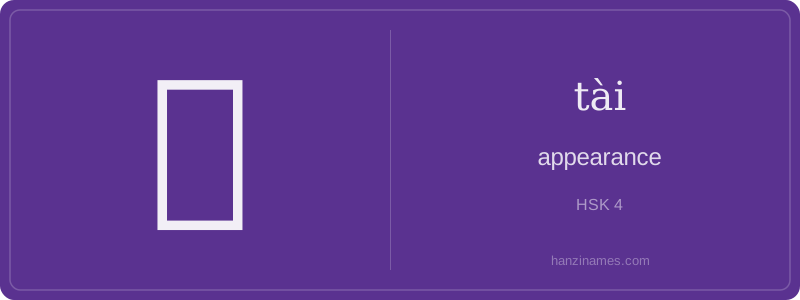
In modern China, 态 appears constantly in official, educational, and digital contexts: government notices cite ‘public order and social stability’ (社会治安和公共秩序状态), teachers evaluate students’ ‘learning attitude’ (学习态度), and smartphone battery settings display ‘power-saving mode status’ (省电模式状态). The idiom ‘好高骛远,态度不端’ (hào gāo wù yuǎn, tàidù bù duān)—‘aiming too high while holding an improper attitude’—is widely used in moral education texts since the 1980s.
The character 态 is a post-classical creation—no oracle bone or bronze inscriptions exist. It first appeared in Han-era bamboo slips as 態 (with the ‘heart + ‘will/desire’ (㠯) + ‘great’ (大) structure), then standardized as 态 in the 20th-century simplification. Its modern use centers on observable conduct: from hospital triage forms listing ‘patient’s mental state’ (患者精神状态) to WeChat status updates (朋友圈状态), it names what can be seen, assessed, and improved.
The character 态 (tài) captures not just physical appearance, but the visible manifestation of inner states—attitude, mood, or condition. In daily Chinese, it rarely stands alone; instead, it appears in compound words like 态度 (tài dù, 'attitude') or 状态 (zhuàng tài, 'state' or 'condition'), where it conveys how something *presents itself* to the world. Its heart radical (心) signals its deep link to internal, subjective experience—even though 'appearance' seems external, 态 reflects how inner reality surfaces visibly.
Historically, 态 emerged during the Han dynasty as a variant of 態 (an older form), later simplified to 态 in the 1956 PRC script reform. It was never an oracle-bone or bronze script character—it’s a relatively late semantic-phonetic compound: the 心 radical indicates meaning (mental/emotional domain), and 太 (tài) serves as the phonetic component, also contributing connotations of 'extreme' or 'excess', hinting at how strongly internal states can manifest outwardly.
For learners, 态 is essential for describing human behavior and systemic conditions alike—from a student’s classroom demeanor (学习态度, xuéxí tàidù) to server uptime (系统状态, xìtǒng zhuàngtài). Its versatility makes it foundational at HSK 4: mastering it unlocks precise expression of nuance, judgment, and observation—key in both formal reports and casual feedback, like telling a colleague their presentation ‘lacked confidence’ (态度不够自信).
Example Sentences
Common Compounds
Similar Characters — Don't Mix These Up
Your First Step into Chinese Culture: Get a Chinese Name
Every journey into Chinese begins with a name. Use our free Chinese name generator to create a meaningful, personalized Chinese name that fits you perfectly.
Get My Chinese Name →