戚
Character Story & Explanation
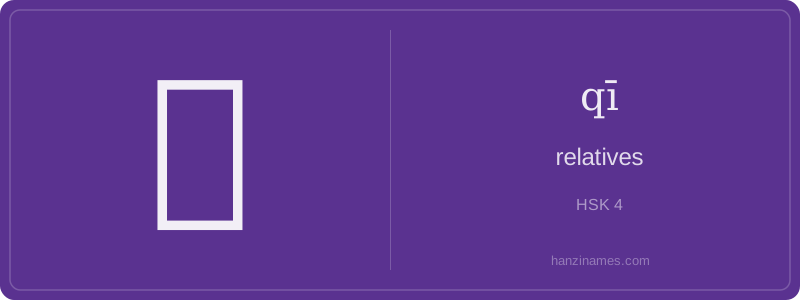
In contemporary Chinese, 戚 appears most frequently in formal writing, legal documents, and idioms—not daily speech. It’s essential in the idiom 亲戚朋友 (qīnqi péngyǒu), meaning 'relatives and friends,' used widely in wedding invitations, obituaries, and New Year greetings. Historically, it appears in the Tang-dynasty legal code *Tanglü Shuyi*, defining inheritance rights among 戚属 (qīshǔ, 'kin'). The character also features in official terminology like 直系亲属 (zhíxì qīnshǔ, 'direct-line relatives') in household registration (hùkǒu) forms.
The character’s form is not pictographic but logographic: its earliest attested shape (in seal script) combines 戈 (radical) and a phonetic component derived from 小/欠. No oracle bone inscriptions of 戚 survive, and its origin is reconstructed via phonological analysis—not visual metaphor—making it a textbook example of a later-developed, function-driven character.
Our detective work begins with the radical 戈 (gē)—the 'dagger-axe,' a Bronze Age weapon symbolizing military authority and lineage. In ancient China, kinship was tightly bound to clan-based warfare and ancestral rites; thus, 戚 emerged not as a generic term for family, but as a marker of blood-related kin bound by shared ritual obligations and inheritance rights.
Etymologically, 戚 is a phono-semantic compound: the left side 戈 provides semantic context (clan identity rooted in martial tradition), while the right side 小 (xiǎo, 'small')—later stylized into 欠—originally suggested phonetic approximation to *qī* in Old Chinese. Over centuries, its meaning narrowed from 'close kin involved in ancestral sacrifices' to the modern sense of 'relatives' or 'kin,' especially in formal or literary contexts.
Unlike colloquial terms like 家人 (jiārén, 'family members'), 戚 carries historical gravity—it appears in classical texts like the *Book of Rites* (Lǐjì) specifying mourning protocols for different degrees of kinship. Its persistence in modern HSK-4 vocabulary reflects how deeply Confucian kinship structures remain embedded in Chinese language, even as everyday usage favors simpler synonyms.
Example Sentences
Common Compounds
Similar Characters — Don't Mix These Up
Your First Step into Chinese Culture: Get a Chinese Name
Every journey into Chinese begins with a name. Use our free Chinese name generator to create a meaningful, personalized Chinese name that fits you perfectly.
Get My Chinese Name →