怀
Character Story & Explanation
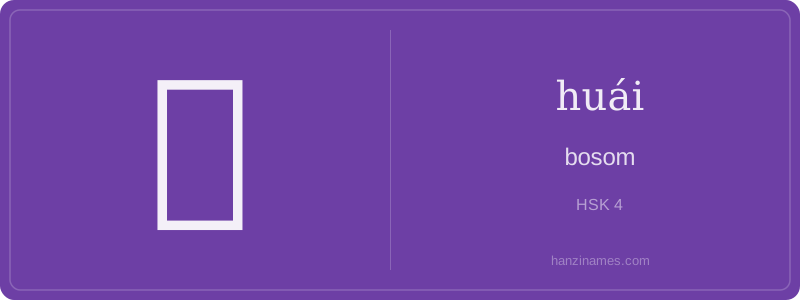
In daily life, 怀 appears in common HSK-4 phrases like 怀疑 (huáiyí, to doubt), 怀念 (huáiniàn, to miss fondly), and 怀孕 (huáiyùn, to be pregnant). It’s central to idioms such as ‘怀才不遇’ (huáicái-bùyù, ‘a talented person overlooked’)—documented since the Tang dynasty—and ‘胸怀宽广’ (xiōnghuái kuānguǎng, ‘broad-minded’), frequently used in education and media. Government reports and news headlines use 怀抱 (huáibào, ‘to embrace’ metaphorically) for policy goals: e.g., ‘怀抱梦想’ (embracing dreams).
The character evolved from seal script, where 忄+褱 (an ancient form meaning ‘to carry in the arms’) merged. While 褱 is obsolete, its phonetic function persists. Today, Chinese people most commonly encounter 怀 in digital contexts—typing ‘怀念’ to caption old photos, or selecting ‘怀旧’ as a filter on Douyin—making it a living bridge between classical emotion and contemporary expression.
Imagine a crisp autumn morning in Beijing’s Nanluoguxiang alley, where an elderly grandmother wraps a warm, hand-knitted scarf around her grandson’s neck. As she tucks the ends gently into his coat, she murmurs, '怀里暖和,别着凉' (‘It’s warm in your bosom—don’t catch a chill’). Here, 怀 isn’t just anatomy—it evokes intimacy, protection, and emotional nearness. The character’s left-side radical 忄 (heart-mind) signals its deep psychological resonance, while the right side ‘不’ (bù) is phonetic—not meaning ‘not’, but anchoring pronunciation huái.
Historically, 怀 appears over 2,000 times in classical texts like the *Zuo Zhuan* and *Shijing*, often expressing heartfelt yearning—‘怀乡’ (huáixiāng, longing for one’s hometown) or ‘怀德’ (huáidé, cherishing virtue). Unlike English ‘bosom’, which feels archaic, 怀 remains vibrantly alive: parents say ‘怀宝宝’ (huái bǎobao) when pregnant; poets write ‘怀古’ (huáigǔ, reflecting on antiquity); even tech users type ‘怀旧滤镜’ (huáijiù lǜjìng, nostalgia filter) on WeChat Moments.
In modern Mandarin, 怀 carries tender gravity—it’s never casual. You wouldn’t say ‘I hold it in my 怀’ about a coffee cup; it’s reserved for what matters: love, memory, responsibility. Its seven-stroke simplicity belies profound cultural weight—like a silk pouch holding heirlooms: small in form, immense in meaning. Learners grasp it best not as ‘chest’, but as the quiet, beating center where care and consciousness meet.
Example Sentences
Common Compounds
Similar Characters — Don't Mix These Up
Your First Step into Chinese Culture: Get a Chinese Name
Every journey into Chinese begins with a name. Use our free Chinese name generator to create a meaningful, personalized Chinese name that fits you perfectly.
Get My Chinese Name →