戴
Character Story & Explanation
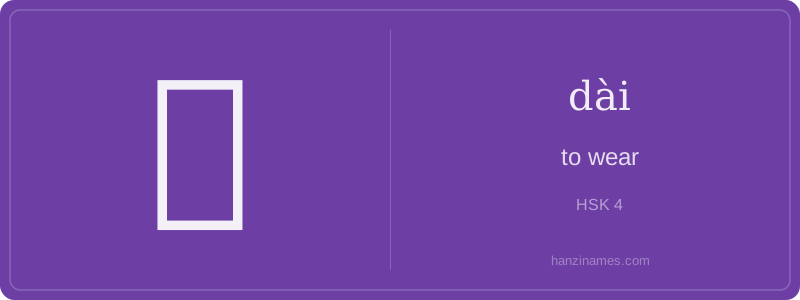
In daily life, 戴 is indispensable: people 戴口罩 (dài kǒuzhào, 'wear masks'), 戴眼镜 (dài yǎnjìng, 'wear glasses'), and 戴婚戒 (dài hūnjiè, 'wear wedding rings'). It appears in HSK 4 vocabulary like 戴帽子 ('to frame someone' — from political campaigns where false accusations were 'placed like hats') and the common phrase 感恩戴德 (gǎn ēn dài dé), meaning 'deeply grateful', literally 'feel grace and wear virtue'. Historically, the *Shuōwén Jiězì* (121 CE) defines 戴 as 'to hold above the head' — confirming its core spatial meaning.
The character’s earliest attested form (in Warring States bamboo texts) shows a person with a prominent headpiece and a phonetic element related to ‘dài’ sound; the 戈 radical likely entered later for phonetic reinforcement (as 戈 and 戴 shared Old Chinese pronunciation *tˤək). No oracle bone form survives — so rather than speculate, observe real use: every morning in Beijing subway stations, dozens check if their ID badge is properly 戴 before swiping in.
Our detective begins at the crime scene: the character 戴, stamped with the 戈 (‘dagger-axe’) radical — an odd choice for ‘to wear’. But this isn’t a mistake; it’s a clue. In ancient bronze inscriptions (c. 11th–3rd century BCE), 戴 originally depicted a person wearing ceremonial headdress or insignia — often linked to ritual authority. The top component 异 (later simplified to 弁-like forms) suggested ‘ceremonial cap’, while 戈 may have served phonetically or symbolized martial rank associated with regalia.
By the Han dynasty, 戴 solidified its meaning as ‘to place upon the head/body’ — not just clothing, but bestowal: to wear a crown, bear a title, or carry moral weight. Its semantic range expanded metaphorically: 戴德 (‘wear virtue’) meant ‘to cherish gratitude’, and 戴罪 (‘wear guilt’) meant ‘to serve while repenting’. This duality — physical placement + moral bearing — reveals how Chinese conceptualizes embodiment as ethical action.
Modern usage retains both layers: you 戴 glasses, a mask, or a badge — but also 戴高帽 (‘wear a tall hat’), an idiom for flattery, echoing ancient court rituals where praise literally elevated one’s symbolic headgear. The 17 strokes aren’t arbitrary: they encode historical hierarchy, ritual gravity, and the quiet insistence that ‘wearing’ is never neutral — it’s an act of identity, status, or accountability.
Example Sentences
Common Compounds
Similar Characters — Don't Mix These Up
Your First Step into Chinese Culture: Get a Chinese Name
Every journey into Chinese begins with a name. Use our free Chinese name generator to create a meaningful, personalized Chinese name that fits you perfectly.
Get My Chinese Name →