户
Character Story & Explanation
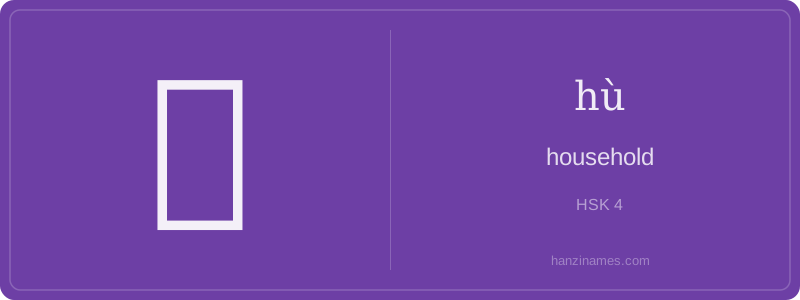
户 is widely used in modern China on official documents, utility statements, and real estate contracts—always referring to the registered household unit. It appears in the national hukou system, established in 1958 and still active, governing residency rights. Common phrases include 户口 (hùkǒu, 'household registration') and 农户 (nónghù, 'rural household'), both central to socioeconomic policy and rural development reports.
Archaeologically, 户 is a simplified form of the ancient character 戸, a pictograph resembling a single-winged door (甲骨文 oracle bone inscriptions show a vertical post and swinging panel). Its original meaning was 'door', evolving semantically to 'household'—since one's door marked the boundary of their domestic unit. This semantic shift from physical entrance to social unit is well-documented in Shuōwén Jiězì (121 CE).
The Chinese character 户 (hù) literally denotes a 'household'—a foundational social and administrative unit in traditional and modern China. Unlike the Western concept of 'family', which emphasizes blood or emotional bonds, 户 carries strong legal and bureaucratic weight: it refers to a registered residential unit recognized by the government, often tied to the hukou (household registration) system. This reflects how deeply governance is interwoven with domestic life in Chinese society.
Historically, the 户 system enabled tax collection, conscription, and grain distribution as early as the Han Dynasty (206 BCE–220 CE). Even today, household registration status affects access to education, healthcare, and housing—making 户 far more consequential than its English gloss 'household' suggests. It’s not just about cohabitation; it’s about civic identity and state-recognized belonging.
In daily usage, 户 appears in official contexts—utility bills, property deeds, census forms—but also in idioms like 门当户对 (mén dāng hù duì), meaning 'socially matched families', underscoring how marital suitability was historically judged by household status. This contrasts sharply with Western individualism, where personal choice often supersedes familial or class alignment. Thus, 户 embodies a collectivist logic where the unit—not the individual—is the primary locus of rights and responsibilities.
Example Sentences
Common Compounds
Similar Characters — Don't Mix These Up
Your First Step into Chinese Culture: Get a Chinese Name
Every journey into Chinese begins with a name. Use our free Chinese name generator to create a meaningful, personalized Chinese name that fits you perfectly.
Get My Chinese Name →