推
Character Story & Explanation
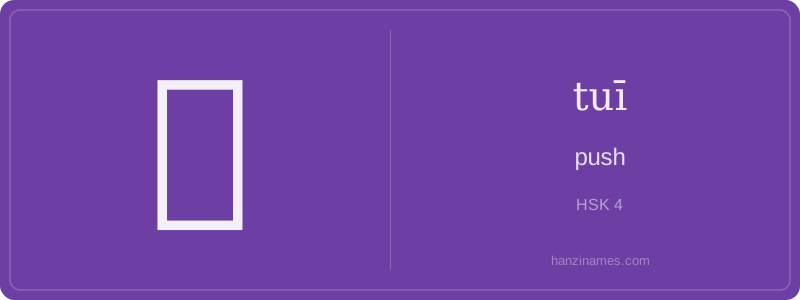
推 is ubiquitous in modern Chinese life: used daily in contexts ranging from tech interfaces ('push notifications' = 推送, tuīsòng) to government campaigns ('promote green energy' = 推广清洁能源, tuīguǎng qīngjié néngyuán). It appears in HSK 4–5 vocabulary and key idioms like 推陈出新 (tuīchén chūxīn, 'discard the old, bring forth the new'), a phrase famously adopted by Mao Zedong in 1942 to describe cultural reform. Historically, 推 was recorded in bronze inscriptions (c. 1000 BCE) and standardized in the Shuōwén Jiězì dictionary (121 CE) as a semantic-phonetic compound.
The character combines 扌 (hand radical, indicating manual action) with 准 (zhǔn, archaic phonetic component, later simplified to 堇). Its earliest form depicted a hand pressing against an object—consistent with its core meaning of 'push'. No oracle bone variant survives definitively, but its consistent hand-based structure across scripts confirms its action-oriented origin.
The Chinese character 推 (tuī) fundamentally means 'to push'—a physical action involving applying force to move something away from oneself. Yet in Chinese linguistic culture, it extends far beyond the literal: it conveys influence, promotion, recommendation, and even logical deduction. Unlike English verbs that often require prepositions or auxiliary words (e.g., 'push forward a policy'), 推 carries rich semantic layers inherently, functioning as both transitive verb and part of compound nouns without morphological change.
This versatility reflects a broader East Asian linguistic tendency where context and compounding—not inflection—drive meaning. For instance, 推出 (tuīchū) means 'to launch (a product)', while 推理 (tuīlǐ) means 'logical reasoning'. Western equivalents like 'push', 'promote', or 'deduce' are separate lexical items; in Chinese, they’re unified under one root ideograph anchored in bodily motion—a cognitive metaphor deeply embedded in the language.
Culturally, 推 resonates with Confucian and Daoist ideas of gentle but persistent influence—like water pushing stone over time (as in the Dao De Jing’s 'the soft overcomes the hard'). In contrast, Western metaphors often emphasize forceful agency ('drive change', 'push back') with implied confrontation. 推, by contrast, can imply respectful, indirect, or systemic action—e.g., 推广 (tuīguǎng, 'popularize') suggests grassroots dissemination rather than top-down imposition, aligning with collectivist values of consensus-building.
Example Sentences
Common Compounds
Similar Characters — Don't Mix These Up
Your First Step into Chinese Culture: Get a Chinese Name
Every journey into Chinese begins with a name. Use our free Chinese name generator to create a meaningful, personalized Chinese name that fits you perfectly.
Get My Chinese Name →