林
Character Story & Explanation
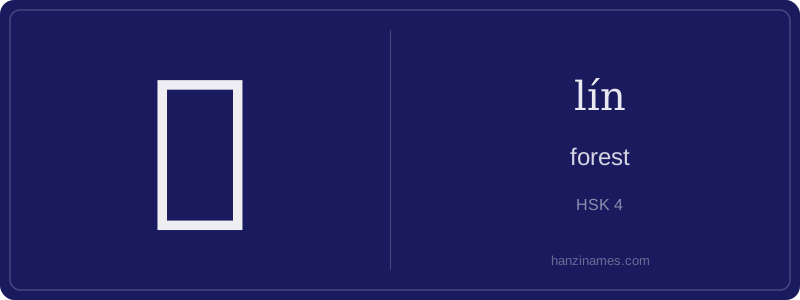
林 is among the top 20 most common Chinese surnames (ranked #18 nationally per 2020 MPS data), with over 14 million bearers—including prominent figures like Lin Yutang and Lin Zhao. It frequently appears in place names (e.g., Xiamen’s Gulangyu Island has ‘Lin Family Garden’ 林氏花园) and idioms like ‘双木成林’ (shuāng mù chéng lín, ‘two trees make a forest’), emphasizing collaboration. As a semantic component, it appears in over 200 characters related to wood, plants, or growth.
The character is a clear ideographic compound: two 木 (‘tree’) radicals side-by-side, first attested in bronze inscriptions of the Western Zhou (c. 1046–771 BCE). Its structure visually encodes its meaning—no abstract derivation needed. Unlike pictographs like 日 (sun), 林 was never a single-object drawing; it emerged directly as a logical doubling to signify density and collective presence.
林 (lín) is a deceptively simple character that embodies the Chinese worldview of harmony through multiplicity. Its dual 木 (mù, 'tree') components suggest not just abundance, but relational balance—two trees standing together form a grove, implying interdependence rather than isolation. This reflects a core Confucian and Daoist value: strength and vitality emerge not from singularity, but from thoughtful coexistence within a shared environment.
In classical Chinese thought, forests symbolize both nourishment and boundary—places where civilization meets wilderness, order meets spontaneity. 林 appears in foundational texts like the *Shuōwén Jiězì* (121 CE) as a semantic compound meaning ‘dense growth of trees’, reinforcing the idea that meaning arises from repetition and context, not isolated elements. The character thus teaches that identity is relational: one tree is vulnerable; two become shelter, habitat, and resilience.
This relational logic extends beyond nature into society: surnames like 林 (common among Han Chinese and Hokkien communities) carry ancestral weight—not as static labels, but as living links to lineage, migration, and communal memory. Even its Japanese reading *Hayashi* retains this ecological resonance, historically denoting families who lived near or managed woodland areas. Thus, 林 is more than ‘forest’—it’s a quiet manifesto on belonging, continuity, and quiet collective strength.
Example Sentences
Common Compounds
Similar Characters — Don't Mix These Up
Your First Step into Chinese Culture: Get a Chinese Name
Every journey into Chinese begins with a name. Use our free Chinese name generator to create a meaningful, personalized Chinese name that fits you perfectly.
Get My Chinese Name →