案
Character Story & Explanation
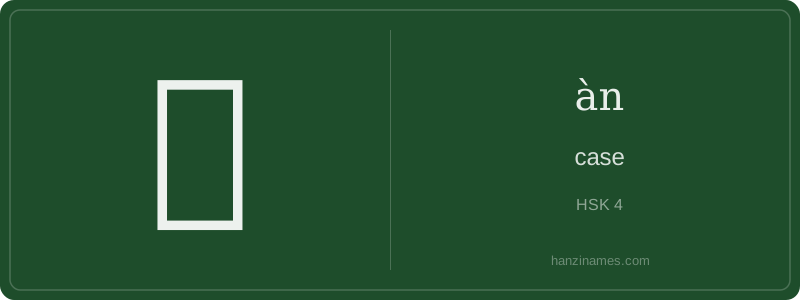
In modern Chinese usage, 案 most commonly appears in official, legal, and academic domains: 新闻报道了一起重大经济案件 (xīnwén bàodào le yī qǐ zhòngdà jīngjì ànjiàn) — 'News reported a major economic case.' It’s central to phrases like 破案 (pò’àn, 'solve a case') and 立案 (lì’àn, 'register a case'), both standard procedures in China’s judicial system. The term also appears in historical records dating to the Han dynasty, where local magistrates adjudicated disputes at wooden desks—the literal origin of the character’s semantic extension.
Documented in the Shuōwén Jiězì (121 CE), 案 is defined as a 'low table for holding things,' pictographically composed of 木 (wood) and ān (a phonetic component meaning 'peace' or 'quiet'). Though not a pictograph per se, its form reflects its original function: a flat, stable surface—like a magistrate’s desk—upon which facts were arrayed and examined.
The character 案 (àn) embodies a quiet yet profound layer of Chinese epistemology: truth is not abstract but anchored in tangible, examined reality. Historically, an 'àn' was a low wooden table—firm, level, and stable—where officials laid out documents, evidence, and verdicts. This physical object became the metaphor for any matter requiring careful review: a legal case, a research topic, or even a policy proposal. The radical 木 (wood) roots the concept in materiality, reminding us that Chinese thought often grounds abstract ideas in concrete, functional objects.
Unlike Western notions of ‘case’ as a self-contained unit of logic or law, 案 carries an implicit procedural weight—it implies investigation, documentation, and authoritative resolution. To ‘handle an àn’ is to follow due process; to ‘file an àn’ is to initiate formal scrutiny. This reflects Confucian-influenced governance ideals: justice must be visible, recorded, and deliberated upon a shared surface—the 案—symbolizing transparency and collective accountability.
Even today, 案 appears in contexts where intentionality and institutional gravity converge: academic research topics (课题, kētǐ), criminal investigations (案件, ànjiàn), and government policy drafts (提案, tí’àn). Its ten-stroke structure—balanced, symmetrical, with the wood radical anchoring the upper ‘ān’ (peace/quiet) component—mirrors its cultural function: a calm, orderly platform for resolving complexity. In this way, 案 is less a noun than a cultural ritual space made lexical.
Example Sentences
Common Compounds
Similar Characters — Don't Mix These Up
Your First Step into Chinese Culture: Get a Chinese Name
Every journey into Chinese begins with a name. Use our free Chinese name generator to create a meaningful, personalized Chinese name that fits you perfectly.
Get My Chinese Name →