桶
Character Story & Explanation
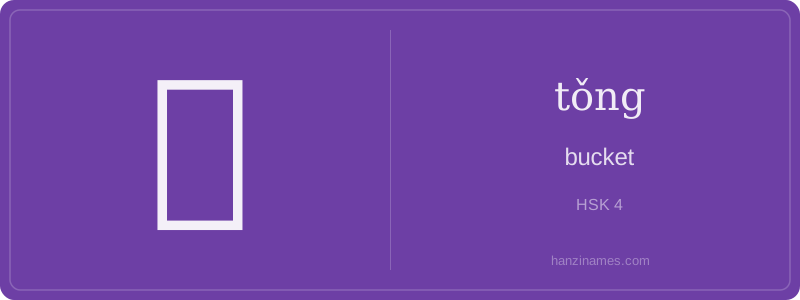
In rural Sichuan villages, elders still use hand-woven bamboo 桶 to carry well water—each household owns several, often labeled with family names. Urban Chinese today encounter 桶 daily: plastic drinking-water jugs (饮用水桶), cooking oil containers (食用油桶), and even slang like ‘刷桶’ (shuā tǒng), meaning 'to repeatedly refresh a webpage'—borrowing the image of scooping and refilling. The term 一桶 (yì tǒng) is standard for quantifying liquids: one bucket of paint, soy sauce, or disinfectant.
The character’s form dates to the Qin bamboo slips (c. 3rd century BCE), where 桶 already depicted a cylindrical vessel. Its right component 甬 was borrowed for sound, not meaning—it’s unrelated to ‘passage’ here. No oracle-bone or bronze inscriptions survive for 桶, confirming its later emergence as a practical, post-Shang lexical innovation tied to craft technology.
The character 桶 (tǒng) literally means 'bucket'—a simple, sturdy container traditionally made of wood, bamboo, or metal. Its radical 木 (mù, 'tree') signals its historical material origin: early buckets were crafted from hollowed-out logs or bound wooden staves. In modern usage, 桶 extends metaphorically to any cylindrical, open-top container—plastic water jugs, oil drums, even data 'buckets' in cloud computing (e.g., AWS S3 buckets).
As an HSK Level 4 character, 桶 appears frequently in daily vocabulary related to storage, transport, and measurement. It’s rarely used alone but commonly appears in compounds like 水桶 (shuǐtǒng, 'water bucket') or 一桶 (yì tǒng, 'one bucket [of something]'). Its pronunciation tǒng is a third-tone syllable, requiring a falling-rising pitch—practicing it with the phrase 一桶水 (yì tǒng shuǐ) helps anchor both tone and usage.
Unlike abstract characters, 桶 retains strong visual logic: the left side 木 hints at wooden construction; the right side 甬 (yǒng), originally a pictograph of a covered passage or conduit, here functions phonetically while subtly evoking the hollow, tubular shape. This blend of semantic and phonetic elements makes it a classic example of a phono-semantic compound—a foundational structure for over 80% of Chinese characters.
Example Sentences
Common Compounds
Similar Characters — Don't Mix These Up
Your First Step into Chinese Culture: Get a Chinese Name
Every journey into Chinese begins with a name. Use our free Chinese name generator to create a meaningful, personalized Chinese name that fits you perfectly.
Get My Chinese Name →