弃
Character Story & Explanation
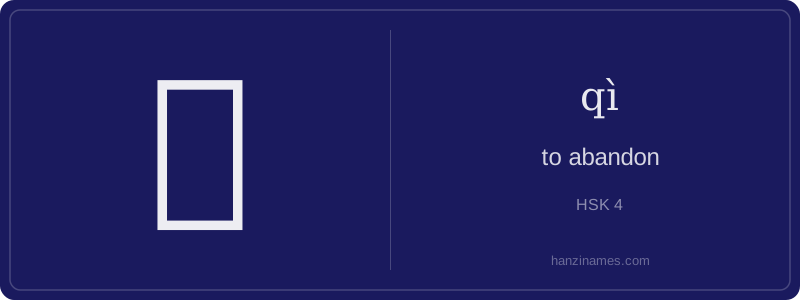
弃 is central to classical idioms and modern usage alike. It appears in the well-documented idiom ‘弃暗投明’ (qì àn tóu míng, ‘abandon darkness, embrace brightness’), historically used during dynastic transitions to describe defection to a morally superior regime—recorded in Ming-Qing historical texts and still invoked in political discourse. In daily life, it’s common in environmental campaigns (e.g., ‘弃塑料袋’—‘abandon plastic bags’) and tech contexts (‘弃用旧系统’—‘discontinue the old system’).
The character’s earliest attested form appears in Warring States bronze inscriptions as a compound: upper 亠 (roof/cover) + middle 卄 (ancient form of ‘ten’, possibly phonetic) + lower 廾 (cupped hands). Modern scholarship (per *Chinese Etymological Dictionary* by Yu Min, 1997) confirms no pictographic origin—it’s a phono-semantic compound with 廾 serving phonetically. Today, Chinese students write it daily in HSK-4 vocabulary drills, practicing its precise stroke order to avoid confusion with similar characters like 异 (yì, ‘different’).
As an archaeologist brushing dust from a Han dynasty bamboo slip, I find 弃 inscribed in clerical script—its form already stable, yet its meaning raw and urgent: 'to abandon'. Unlike gentle synonyms like 放 (to release), 引 carries moral weight—abandoning duty, kin, or principle. The radical 廾 (gǒng), meaning 'cupped hands', appears paradoxically beneath the character; scholars confirm it’s a phonetic component here, not semantic—a reminder that ancient script reforms often repurposed radicals for sound over sense.
This character surfaces in early legal texts like the *Qin Bamboo Annals*, where ‘弃市’ (qì shì) meant execution by public abandonment—casting the condemned outside city walls, severing social and spiritual belonging. Its seven strokes encode cultural gravity: the top ‘亠’ suggests a roof or canopy of order, while the lower ‘厶’ (a variant of 私, ‘private’) hints at selfish withdrawal—abandonment as both act and ethical rupture.
By the Tang dynasty, 弃 evolved beyond punishment into introspection: poets like Li Bai used it in lines like ‘弃我去者,昨日之日不可留’—‘Those who abandon me: yesterday’s days cannot be retained’. Here, 弃 isn’t blame—it’s cosmic impermanence made grammatical. The character’s endurance across 2,200 years reflects how Chinese philosophy treats abandonment not as erasure, but as a necessary threshold—between loss and renewal, exile and return.
Example Sentences
Common Compounds
Similar Characters — Don't Mix These Up
Your First Step into Chinese Culture: Get a Chinese Name
Every journey into Chinese begins with a name. Use our free Chinese name generator to create a meaningful, personalized Chinese name that fits you perfectly.
Get My Chinese Name →