歉
Character Story & Explanation
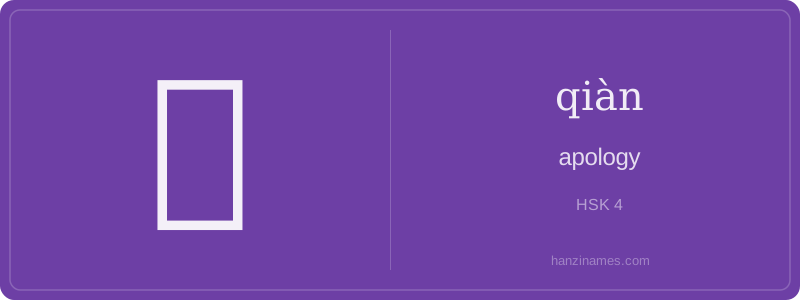
In daily life, 歉 appears almost exclusively in fixed compounds — never alone. You’ll hear it in formal apologies (道歉 qiàndào), written notices ('歉意声明' — 'statement of apology'), and customer service contexts (e.g., railway station announcements: '因故晚点,深表歉意'). It’s notably absent in casual speech: native speakers say 对不起 (duìbuqǐ) or 抱歉 (bàoqiàn), not *‘我歉’ — confirming 歉 functions only as a bound morpheme. Historically, the earliest verified use is in the Eastern Han text *Shuōwén Jiězì* (121 CE), which defines 歉 as ‘not sufficient’, later extended to ‘regretful insufficiency’ in Tang dynasty poetry and Ming-Qing vernacular fiction.
The character’s form has no pictographic origin: 欠 is a stylized mouth/yawn glyph, and 兼 is a phonetic component derived from oracle-bone forms of ‘holding two things’. There’s no archaeological evidence of 歉 in oracle bone or bronze inscriptions — it’s a later, learned compound created during the Warring States period for administrative and ritual precision.
Our detective work begins with the radical 欠 (qiàn) — literally 'to yawn' or 'to lack' — which appears in characters related to mouth, breath, and absence. In 歉, this radical anchors the character’s semantic field: apology arises from a sense of deficiency — a moral shortfall requiring redress. The right side, 兼 (jiān), originally depicted two hands holding bamboo slips, signifying 'to hold both' or 'to combine', later evolved to mean 'simultaneous' or 'in addition'. Here, it serves phonetically (sharing the qiàn sound) while subtly reinforcing duality: the speaker acknowledges fault *and* expresses regret.
Historically, 歉 first appeared in seal script (c. 3rd century BCE) as a phono-semantic compound, not a pictograph. Unlike ancient characters for 'sun' or 'tree', it has no visual depiction of apology — no bowing figure, no clasped hands. Instead, its meaning emerged through textual usage: early Confucian texts like the *Book of Rites* (Lǐjì) used 歉 in contexts of ritual humility and self-reproach, linking moral awareness to verbal acknowledgment. Its form stabilized by the Han dynasty, reflecting how Chinese characters often encode ethical concepts abstractly rather than visually.
This character exemplifies how Chinese writing conveys complex social values through structural logic rather than illustration. The fusion of 欠 (lack) + 兼 (phonetic/semantic reinforcement) constructs 'apology' as an act of recognizing one’s insufficiency — culturally resonant in East Asian ethics where harmony depends on acknowledging relational debt. Modern learners might miss this nuance if focusing only on rote memorization; but tracing 歉 reveals that saying 'I’m sorry' in Chinese is linguistically framed as 'I admit my deficiency', making it less about emotion and more about relational accountability.
Example Sentences
Common Compounds
Similar Characters — Don't Mix These Up
Your First Step into Chinese Culture: Get a Chinese Name
Every journey into Chinese begins with a name. Use our free Chinese name generator to create a meaningful, personalized Chinese name that fits you perfectly.
Get My Chinese Name →