止
Character Story & Explanation
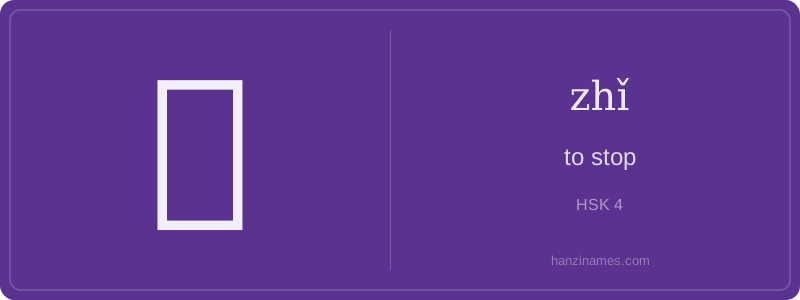
止 is widely used in modern Chinese public signage and formal language: '禁止吸烟' (jìnzhǐ xīyān, 'No smoking'), '止步' (zhǐbù, 'Do not proceed'), and the common warning phrase '此路不通,敬请止步' (This road is closed—please stop here). It also appears in classical texts like the *Analects*, where Confucius uses 止 in moral contexts like '知止而后有定' ('Knowing where to stop brings stability').
Archaeologically, 止 originated as a pictograph of a foot (甲骨文: ) in oracle bone inscriptions—depicting toes and sole—but evolved into an abstract symbol for 'stopping' by the Warring States period. Its foot-like shape was retained, but its meaning shifted from 'foot' to 'to halt', likely due to phonetic-semantic compounding in early script development.
Hi students! Let’s learn 止 (zhǐ), a foundational character meaning 'to stop' or 'to cease'. It’s simple—only four strokes—and appears in many high-frequency words like 停止 (tíngzhǐ, 'to stop') and 制止 (zhìzhǐ, 'to prevent'). Though it looks like a foot in ancient scripts, today it functions almost entirely as a semantic component meaning 'halt'—not movement. Mastering 止 helps you understand verbs of cessation, warnings, and even legal or medical terms.
This character is especially useful because it’s both a standalone verb and a key part of compound words. At HSK 4, you’ll encounter it in reading passages about regulations, safety signs, or daily instructions—like '请止步' ('Please stop here'). Unlike English ‘stop’, 止 rarely stands alone in speech; it prefers compounds for natural usage. Still, recognizing it instantly boosts your vocabulary decoding skills.
Don’t confuse 止 with similar-looking characters like 正 (zhèng, 'correct') or 步 (bù, 'step'). Its top stroke is flat and horizontal—not slanted—and the two short strokes underneath are symmetrical, like feet planted firmly. Practice writing it slowly: horizontal stroke first, then vertical, then two short diagonals—like pressing pause with both feet. Repetition builds muscle memory, and soon you’ll spot 止 everywhere—from subway signs to smartphone notifications!
Example Sentences
Common Compounds
Similar Characters — Don't Mix These Up
Your First Step into Chinese Culture: Get a Chinese Name
Every journey into Chinese begins with a name. Use our free Chinese name generator to create a meaningful, personalized Chinese name that fits you perfectly.
Get My Chinese Name →