吃
Character Story & Explanation
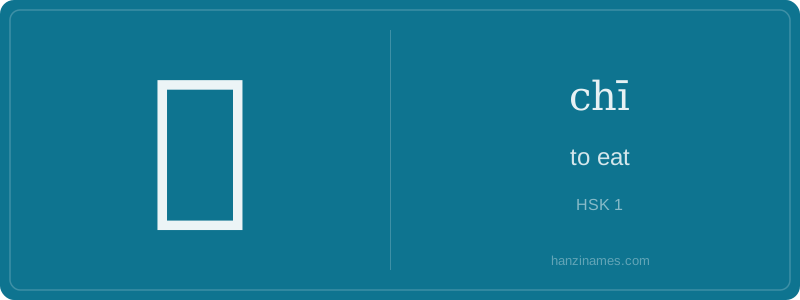
吃 is the most common verb for 'to eat' in Modern Standard Chinese and appears in countless daily expressions—from casual invitations ('Let’s eat!') to bureaucratic euphemisms ('He ate the blame' = accepted responsibility). It features in idioms like 吃一堑,长一智 (chī yī qiàn, zhǎng yī zhì: 'Eat one pit, gain one wisdom' — learn from mistakes) and historical texts like the 13th-century *Menggu Ziyun*, where it consistently denotes oral consumption. As a core HSK Level 1 verb, it's among the first 150 characters taught to learners.
The character is not pictographic. Its earliest attested form appears in clerical script (Lìshū) of the Han dynasty (~206 BCE–220 CE); no oracle bone or bronze inscriptions contain 吃. The 口 radical clearly signals oral action, while 乞 serves primarily as a phonetic component (though historically related to 'beg'). Today, Chinese speakers use 吃 constantly—for meals, snacks, medicine, even abstract concepts: 'eating bitterness' (chī kǔ) means enduring hardship.
As an archaeologist brushing dust from a Han dynasty bamboo slip, I uncover 吃 not as a static glyph—but as a living ritual gesture frozen in ink. Its 口 (mouth) radical isn’t mere decoration; it’s a functional frame, anchoring the action squarely in the body’s most primal aperture. The right-hand component, 乞 (qǐ), originally meant ‘to beg’ or ‘to plead’—suggesting early conceptual links between eating and dependence, sustenance as supplication. This wasn’t just ingestion—it was relational: eater to food, human to heaven, subject to ruler.
Excavations of Warring States bronze inscriptions reveal early variants where the ‘begging’ element appears more angular, almost claw-like—evoking grasping, urgency, necessity. By the Qin standardization, 吃 stabilized into its modern six-stroke form, shedding pictorial literalism but retaining semantic gravity. Unlike purely pictographic characters like 日 (sun), 吃 emerged through phono-semantic compounding—a deliberate fusion of sound (chī, approximated by 乞) and meaning (mouth + action). It’s linguistic stratigraphy: layer upon layer of social value compressed into six strokes.
What astonishes me is its resilience across millennia: while other food-related characters faded or specialized, 吃 expanded—absorbing metaphors (‘eat up’ time, ‘eat’ criticism, ‘eat’ losses), surviving dynastic shifts, and becoming the default verb for consumption in Mandarin, Cantonese, and many Sinitic varieties. Its ubiquity mirrors rice itself: unassuming, essential, endlessly adaptable. To study 吃 is to excavate not just script, but the anthropology of hunger, hospitality, and human rhythm.
Example Sentences
Common Compounds
Similar Characters — Don't Mix These Up
Your First Step into Chinese Culture: Get a Chinese Name
Every journey into Chinese begins with a name. Use our free Chinese name generator to create a meaningful, personalized Chinese name that fits you perfectly.
Get My Chinese Name →